
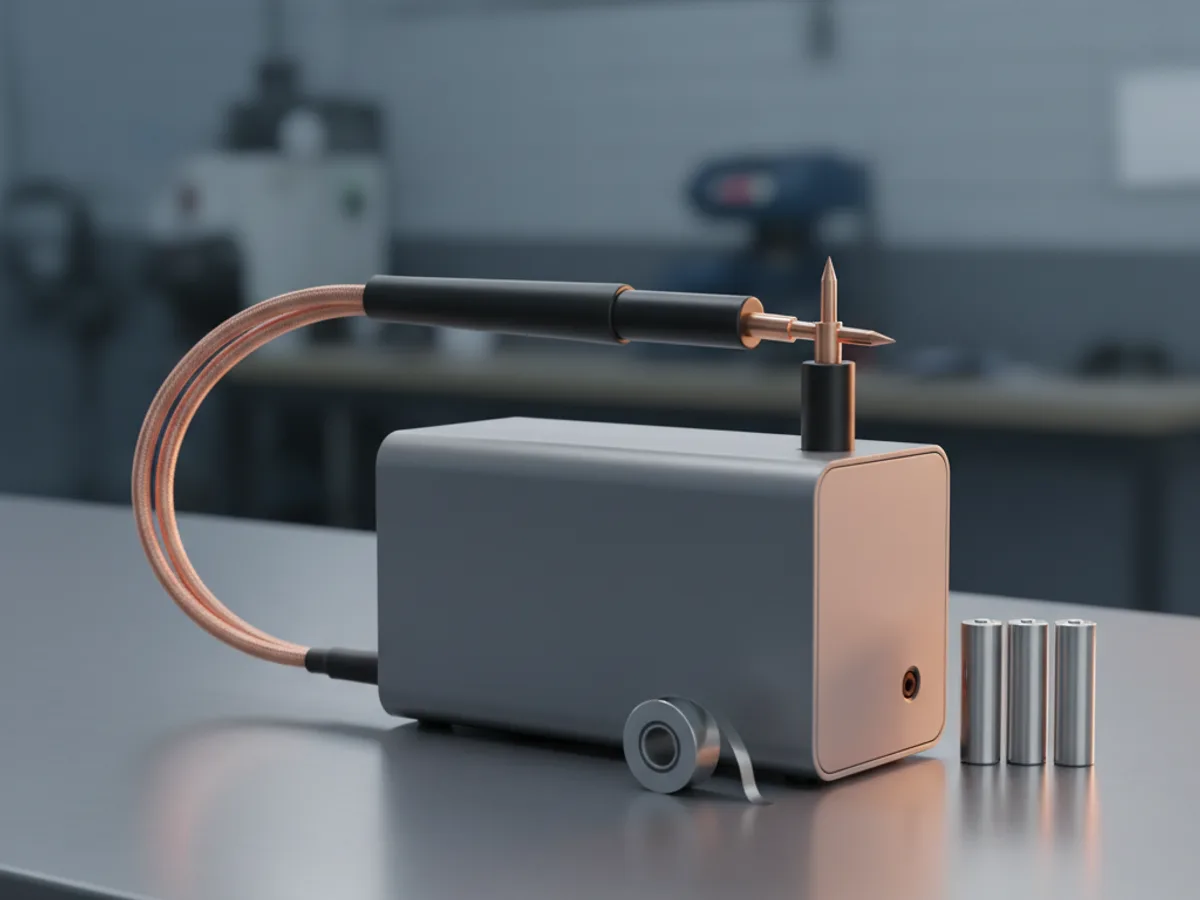


Why battery cells are welded and not soldered
Soldering a tab to a lithium cell means holding an iron against the can long enough for the whole joint area to reach solder temperature. That heat goes straight into the cell, and heat is exactly what damages the internals and the safety vent. Even where it appears to work, capacity and cycle life suffer and the risk of a later failure rises.
Spot welding inverts the problem. The current is concentrated at the contact point and the pulse lasts a few thousandths of a second, so the metal at the interface melts and fuses while the body of the cell barely warms. Put a finger on a cell straight after a weld and it is cool.
That is the whole case for the tool. It is not a convenience over soldering, it is the method that does not degrade the cell, which is why every commercially built pack is welded.
| Nickel strip | Typical use | Machine needed |
|---|---|---|
| 0.1 to 0.15 mm | Light packs, low current draw | Small portable welders manage this |
| 0.2 mm | General 18650 pack building | Mid range, the common working point |
| 0.25 to 0.3 mm | Higher current packs | Needs the upper end of these machines |
| Above 0.3 mm | High drain packs, parallel strips | Beyond most portable units |
Pulse energy, and what the big numbers mean
These machines are quoted in amps, in kilowatts, or by the capacitor bank behind them. Those figures are all describing the same thing from different angles: how much energy the machine can dump into the joint in one pulse. More energy welds thicker strip, and a machine short of energy simply cannot make a sound weld in thick nickel however many times you try.
Capacitor discharge machines store energy slowly and release it very fast, which is why a small unit can quote a peak current in the thousands of amps. That peak is real but it is momentary, and the useful comparison between machines is the strip thickness each one claims rather than the headline current.
Most machines offer a double pulse. The first, shorter pulse breaks through surface oxide and settles the electrodes onto the metal; the second does the welding into a now clean, seated contact. It is worth using where it is offered, because it makes welds far more consistent than a single pulse of the same total energy.
Pure nickel or nickel plated steel
Two strips look almost identical and behave differently. Pure nickel has low electrical resistance, so it carries pack current with little loss and little heating, and it is what high drain packs need. Nickel plated steel is cheaper, has considerably higher resistance, and is adequate for low current packs.
Confusingly, the cheaper strip is often the easier one to weld. Its higher resistance means more heat develops at the joint for the same pulse, so a weak machine can appear to work well on plated steel and then fail to weld pure nickel of the same thickness. If a machine welds one and not the other, that is the reason.
A magnet is the field test. Nickel plated steel is strongly attracted; pure nickel is only very weakly magnetic. It is worth checking a new roll rather than trusting a description, because the two are frequently mislabelled and the difference matters in a pack that draws real current.
Electrodes, pressure and testing the weld
Electrode tips need to be clean and shaped. They pick up nickel and burn over use, and a rounded, contaminated tip spreads the current over too large an area to reach welding temperature. Dressing them back to a clean point with a file or fine abrasive restores performance more often than turning the power up.
Pressure matters as much as energy. Too little and the current arcs rather than conducting, blowing a hole and spattering. Too much and the tips push the strip hard against the cell so the contact resistance drops, which reduces the heat generated. Firm and consistent, with the tips square to the work, is what gives repeatable welds.
Test rather than assume. A good weld resists a firm pull on the strip and tears the nickel before it releases from the cell; a poor one peels away cleanly leaving a mark. Weld a scrap cell and a scrap strip at your chosen setting, pull it apart, and only then start on the pack.