
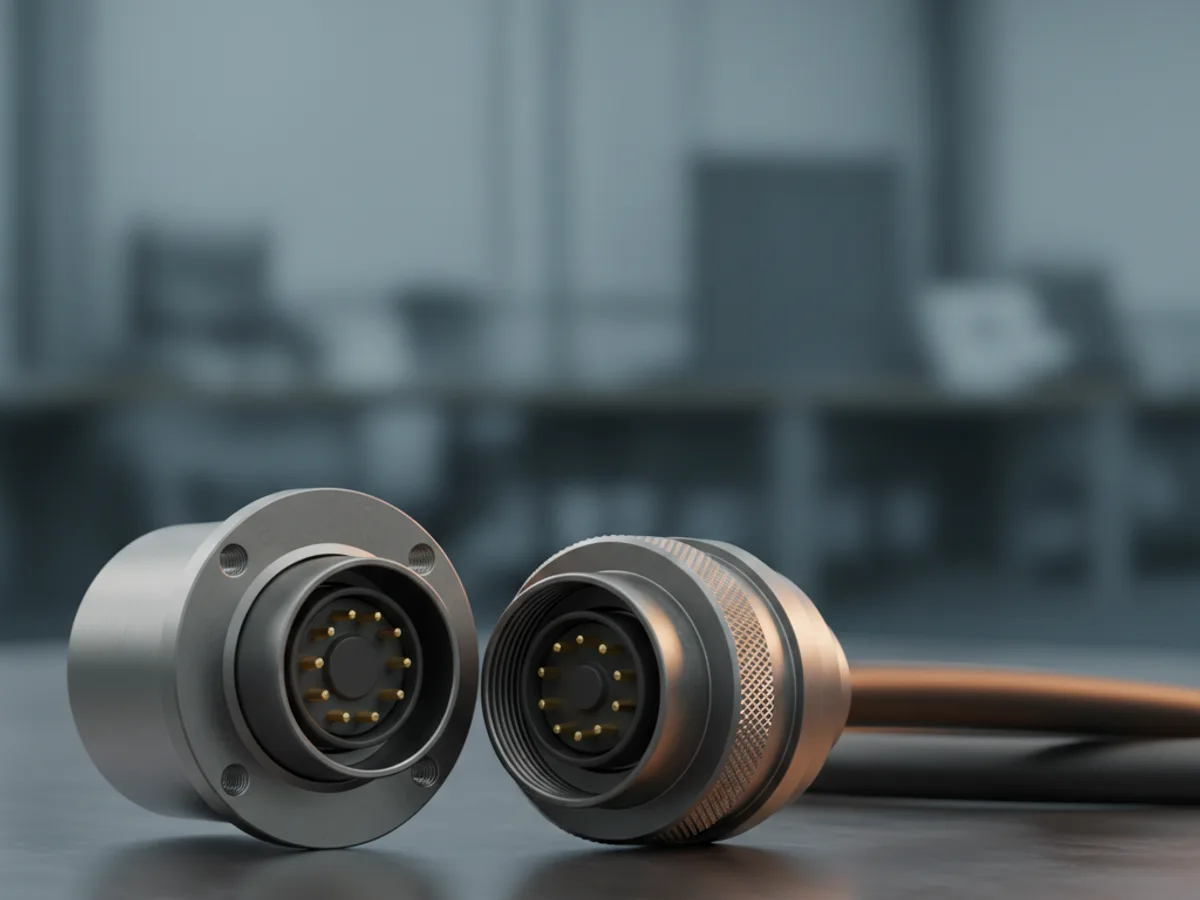


GX16, SP21 and why nothing here is an aviation part
Almost every listing in this class is described as an aviation connector or an aviation plug. It is a translation convention rather than a claim about aircraft, and it is worth saying plainly: these are general purpose industrial circular connectors. They are not certified aviation components and nothing about the name implies a qualification standard. Buy them for machines, lighting, robotics and enclosures, not for anything that flies.
The series codes are more useful than the name. In the GX family the number is the shell diameter in millimetres, so GX12, GX16, GX20 and GX25 tell you directly what panel cutout you need and roughly how much current the shell can carry. GX16 is the common general purpose size. The SP family, SP13 through SP29, works the same way but uses a push and twist bayonet with a moulded body and is the one usually sold as IP68 rated.
Two specialised types also appear. Socapex 19 pin is the entertainment industry multicore standard, carrying six lighting circuits down one cable. PowerCON style connectors are locking mains couplers used in audio and staging, made in deliberately non-interchangeable input and output versions so you cannot chain them the wrong way round.
| Series | The number means | Coupling | Typical use |
|---|---|---|---|
| GX12 to GX25 | Shell diameter in millimetres | Threaded collar | Sensors, motors, panel wiring |
| SP13 to SP29 | Shell diameter in millimetres | Push and twist bayonet | Outdoor and washdown, LED installs |
| M12 and M16 | Thread diameter in millimetres | Threaded, often keyed | Industrial sensors and fieldbus |
| Socapex 19 pin | Contact count | Threaded shell | Six lighting circuits on one multicore |
| PowerCON style | Not a size code | Locking, keyed in and out | Mains distribution in audio and staging |
What an IP68 rating actually covers
IP ratings come from IEC 60529 and the second digit is the water one. IPX7 means the enclosure survives immersion in one metre of water for thirty minutes. IPX8 means continuous immersion under conditions the manufacturer states, which is why an IP68 claim is only meaningful alongside the depth and duration the maker specifies. IPX6 is powerful water jets, not immersion, and for most outdoor equipment that is the rating that actually matters.
The critical detail is that the rating applies to the connector mated and correctly assembled. An unmated half is not sealed unless it has a screw-on cap fitted, and a great many outdoor failures are simply a socket left open over winter. The rating also assumes the cable gland has been tightened onto a cable of the right diameter, and that the panel gasket is present and seated. A connector with the correct rating fitted through a slightly oversize panel hole is not sealed at all.
Water usually gets in along the cable rather than through the front of the connector. Where a cable runs downhill into a plug, moisture tracks along the sheath and collects at the joint, so leaving a drip loop below the connector is worth more in practice than a higher IP number.
Current is rated per contact, not per connector
A five pin connector rated at five amps per contact is not a twenty five amp connector. The per contact figure assumes a single contact carrying that current with the others cool, and loading every contact at once raises the temperature inside the shell for all of them. Manufacturers publish a derating curve for exactly this reason, and the practical rule is to leave headroom rather than working to the maximum on every pin.
Ambient temperature counts against the same budget. A connector inside a hot enclosure or in direct summer sun is already part way up its temperature rise before any current flows. Where a connector runs warm to the touch under normal load, it is being asked for too much, and the usual outcome is a contact that oxidises, rises in resistance, gets hotter still and eventually fails.
Conductor size has to suit the contact as well as the load. Contacts are made to crimp or solder a range of conductor cross sections, and forcing oversized cable into a small contact gives a poor joint that heats up. If the cable will not fit the contact, the connector is the wrong size for the job.
Plating, keying and getting the wiring the right way round
Contact plating is a genuine specification difference. Gold over nickel gives low and stable contact resistance and resists corrosion, which is what you want for signal levels and for anything that gets mated and unmated often. Silver carries higher current better but tarnishes. Plain nickel or tin is the budget option and is adequate indoors on power circuits that stay connected.
Every circular connector of this type is keyed, usually with a slot and rib in the shell, so it can only mate one way. That does not stop the other classic error, which is wiring the pins to the wrong numbers. Pin numbering is moulded into the insulator on both halves and it is easy to read the socket as a mirror of the plug and get it backwards. Check the numbering on each half individually, and on anything carrying mains, agree a convention and label it.
On power connectors, decide deliberately which half is the live side. Convention is that the half which remains energised when the pair is separated should be the socket, with recessed female contacts, so there are no exposed live pins. A great many cheap assemblies ignore this, which is worth checking before you fit one on a mains circuit.