How block machine model numbers work
Most machines in this class use a QT designation, and the numbers tell you the output. In QT4-15, the 4 is blocks per cycle for a standard 400 by 200 by 200mm hollow block, and the 15 is the cycle time in seconds.
So QT4-15 makes four blocks every 15 seconds, QT6-15 makes six, and QT10-15 makes ten. Larger first numbers mean a bigger mould table, more vibration power and a heavier frame.
Compare machines on blocks per shift rather than per cycle, because cycle time varies and a machine with a longer cycle but a bigger table can still win.
| Model | Blocks per cycle | Cycle | Blocks per shift |
|---|---|---|---|
| QT4-15 | 4 | 15 to 20 s | 2,880 to 3,840 |
| QT4-24 | 4 | 20 to 25 s | 2,300 to 2,880 |
| QT6-15 | 6 | 15 to 20 s | 4,320 to 5,760 |
| QT8-15 | 8 | 15 to 20 s | 5,760 to 7,680 |
| QT10-15 | 10 | 15 to 20 s | 7,200 to 9,600 |
Blocks, bricks, pavers and kerbs
One machine makes different products by changing the mould. Hollow block, solid block, cinder block, interlocking block, paving stone and kerb all come off the same frame with the right tooling, and mould changeover on a well-designed machine is under an hour.
Budget for moulds separately. A machine is normally quoted with one mould, and each additional product needs its own. On a production business the mould set is a meaningful part of the total investment.
Raw materials are cement, aggregate and often fly ash. The mix for machine-made block is much drier than poured concrete, since the block has to hold its shape the instant it leaves the mould.
Manual, semi-automatic and fully automatic
Manual and egg-laying machines are cheap and need a large crew. They suit low volumes and sites without reliable power.
Semi-automatic machines handle vibration, compression and ejection but need people feeding the mixer and moving pallets. This is where most small block yards sit.
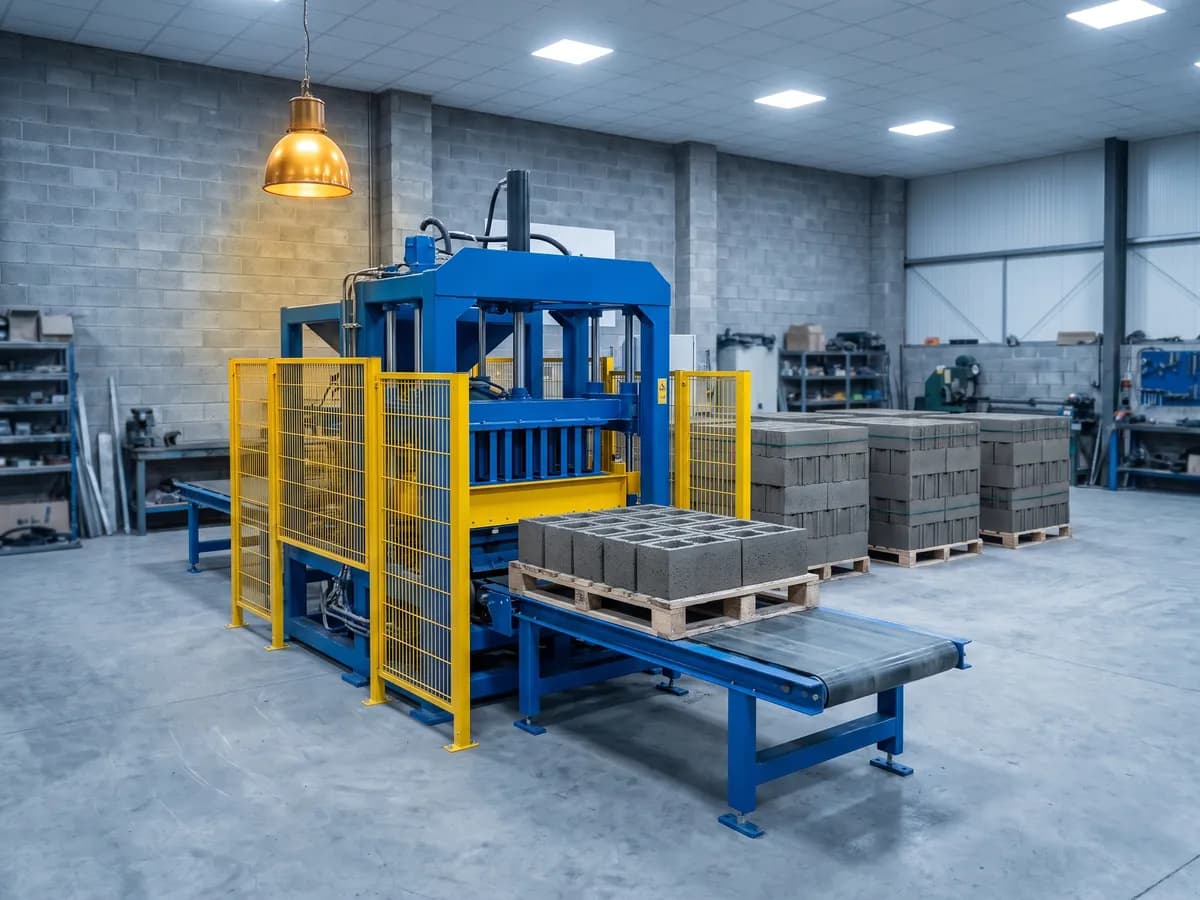
Fully automatic machines add PLC control, a forced mixer with conveyor feed, automatic pallet handling and often a stacker. The crew drops to two or three and output roughly doubles for the same shift, but the capital cost and the space required both rise sharply.
The deciding question is pallets. A fully automatic line produces pallets faster than people can move them, so it needs a pallet handling system and curing space to match, or the machine simply waits.
What the site needs
Power is the first check. A QT4-15 draws around 13 kW installed across the vibration motors, hydraulic pump and mixer, and three-phase supply is required.
Floor area matters more than machine footprint. The machine itself is around 5.5 by 1.8 metres, but the curing yard, aggregate stockpiles and pallet storage take several times that.
Pallets are a consumable. Steel, wood and PVC pallets all work; wood is cheapest and wears fastest. Count on holding at least a full day of production in pallets so the machine never waits for one.