
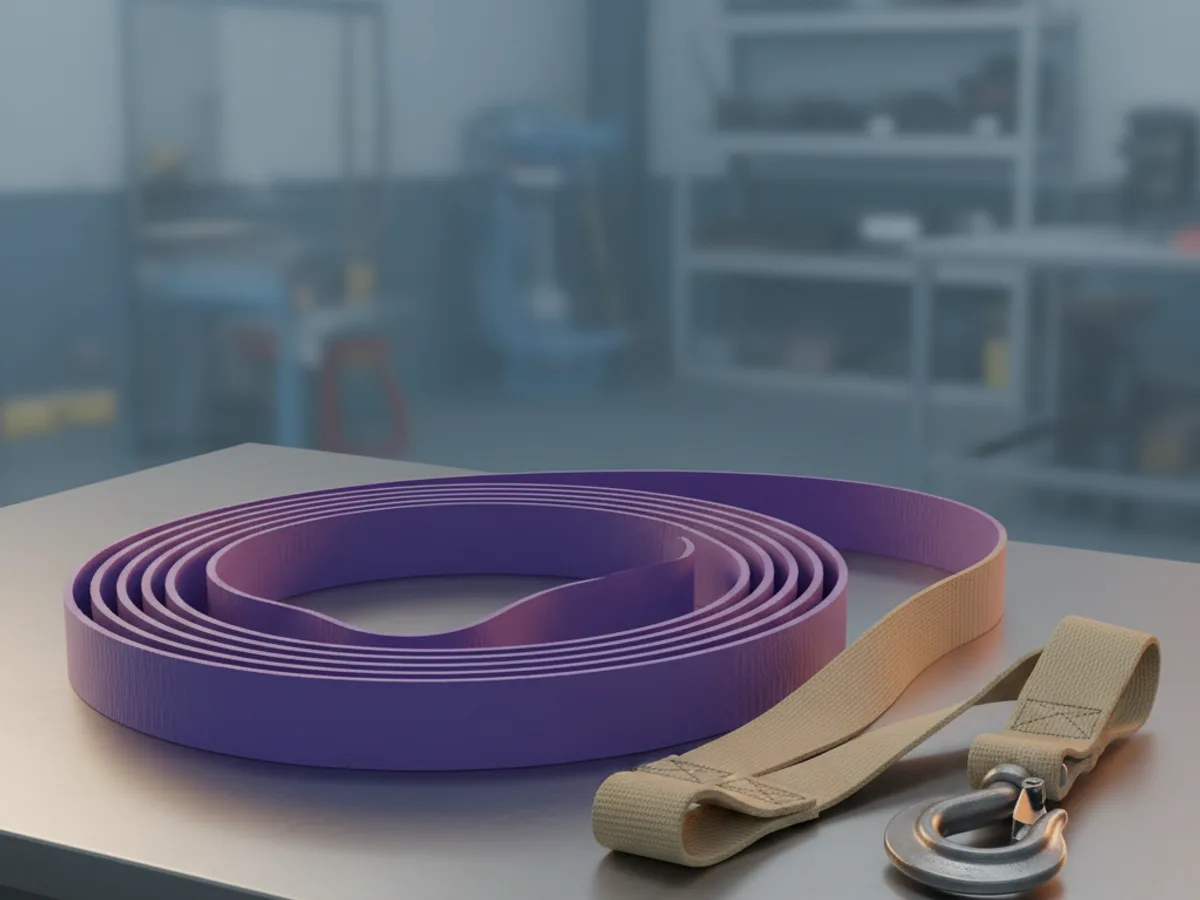


Round, flat webbing and chain
A round sling is an endless loop of load bearing polyester yarn inside a woven protective sleeve. The sleeve carries none of the load; it exists to protect the core. That construction makes a round sling soft, light and gentle on finished surfaces, and it makes any damage to the sleeve serious, because you cannot see the core to judge it.
A flat webbing sling is woven as a strap with sewn eyes. It lies flat against a load, which spreads pressure over a wider area, and it is easier to inspect because the load bearing material is visible along its whole length.
Chain slings in alloy steel are the choice where textile will not survive: heat, sharp edges, abrasive loads and outdoor use over years. They do not stretch, they can be shortened with a grab hook, and they are heavy to handle and will mark a finished surface.
| Type | Suits | Weakness |
|---|---|---|
| Round sling | Delicate finishes, soft grip, light handling | Core hidden inside the sleeve |
| Flat webbing sling | Spreading pressure, easy inspection | Cut by sharp edges |
| Chain sling | Heat, sharp edges, outdoor and heavy use | Heavy, marks finished surfaces |
Sling angle, which catches people out
When two legs share a load, the tension in each leg depends on the angle between them. With the legs nearly vertical, each takes roughly half the load. As the legs spread toward horizontal, the tension in each rises, and it rises fast rather than gradually.
By the time the included angle between the legs reaches sixty degrees, each leg is carrying noticeably more than half. Spread further and the multiplication grows sharply, which is how a two leg sling comfortably rated for a load fails lifting that same load off a wide object.
The practical rules are to keep the legs as steep as headroom allows, to use a spreader beam where the pick points are far apart, and to read the capacity from the tag for the angle actually being used rather than from the vertical figure. Manufacturer tags state capacity at defined angles for this reason.
Straight, choked and basketed
A straight vertical hitch, sling attached at both ends with the load hanging below, is the reference case and gives the rated figure.
A choke hitch passes the sling through its own eye and tightens on the load, which grips a bundle and stops it sliding. It also bends the sling sharply at the choke point, and that bend reduces the capacity, conventionally by around a fifth. It is the right hitch for gripping and the wrong one for maximum capacity.
A basket hitch passes the sling under the load with both ends on the hook, so two parts of the sling share the weight, and it can lift substantially more than the vertical rating. The catch is that the same angle rule applies to the two sides of the basket, and a wide basket loses the advantage quickly. Never knot a sling to shorten it, and never twist it, since both concentrate the load and reduce strength unpredictably.
Edges, labels and taking a sling out of service
Sharp edges are the main killer of textile slings, and a corner does not have to be knife sharp to do it. Under load a sling presses hard into an edge and the fibres are cut through in one lift. Corner protectors and wear sleeves are cheap and they are the difference between a sling lasting years and failing once.
Inspection before every use is straightforward on webbing: look for cuts, abraded edges, pulled stitching, chemical damage showing as stiffness or discolouration, and heat damage showing as glazed or fused fibres. On a round sling, damage to the sleeve means the core cannot be assessed, so the sling comes out of service.
A sling with no legible label is out of service, without exception. The label carries the working load limit, the material and the identification, and a sling whose capacity cannot be read is a sling nobody can use safely. Store slings out of sunlight, since ultraviolet degrades polyester slowly and invisibly, and away from chemicals.