
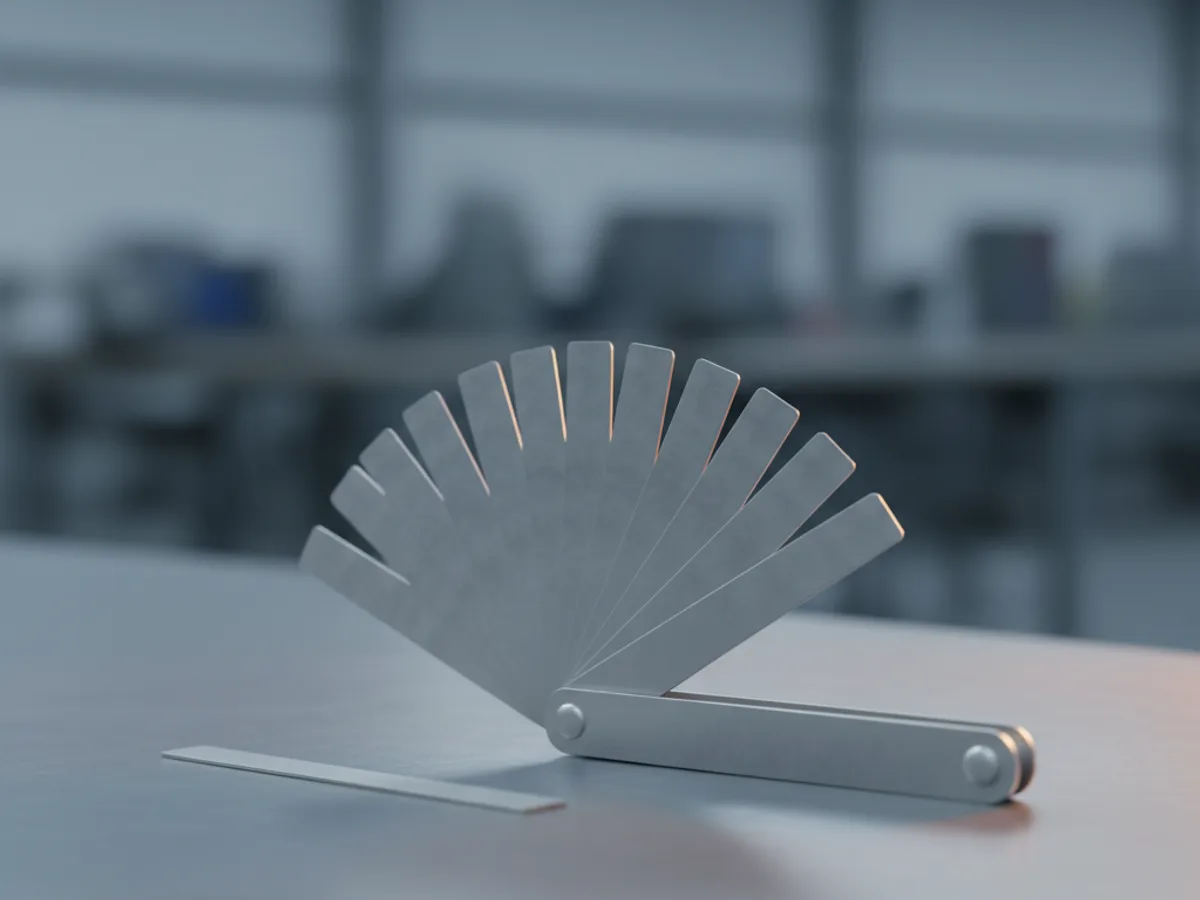


The drag test, which is the whole technique
Slide a blade into the gap. If it goes in loose, the gap is bigger than that blade. If it will not enter, the gap is smaller. The correct blade is the one that enters with a light, even resistance you can feel through your fingers, and the next size up will not go in at all.
That resistance is what the tool measures, and it is why two people can get slightly different readings from the same gap. Consistency comes from using the same light pressure every time and from pulling the blade rather than shoving it, since a blade that has been forced is telling you about the force, not the gap.
Insert straight and square. A blade entering at an angle measures the diagonal of the gap rather than the gap, and reads wide. Where a gap is inside something, work the blade in slowly and stop the moment you feel it bind.
| What happens | Means | Do next |
|---|---|---|
| Blade slides with no resistance | Gap is larger than the blade | Try a thicker blade |
| Blade enters with light drag | This is the measurement | Note the thickness |
| Blade will not enter | Gap is smaller than the blade | Try a thinner blade |
| Blade enters at an angle only | Not measuring the gap | Square it up and repeat |
Stacking blades, and its cost
Sets are made so blades can be combined: two blades held together measure the sum of their thicknesses, which lets a set of common sizes cover intermediate values it does not carry as single blades.
It is legitimate and it is less accurate. Each blade carries its own manufacturing tolerance, so stacking two blades stacks two tolerances, and any dirt or oil film between them adds to the reading. Use the smallest number of blades that gets you there, and clean them first.
Where a single blade of the right size exists, use it. A set with more blades at closer intervals is worth the small extra cost precisely because it means stacking less, and dual marked sets carrying both metric and imperial thicknesses save converting figures in the middle of a job.
Blade sets, tapers and where each belongs
A standard blade set covers small gaps, typically from a few hundredths of a millimetre up to about a millimetre, which is the range that valve clearances, bearing clearances and machine alignment live in.
A taper gauge is a different tool for the same question. It is a wedge marked along its length, pushed into a gap until it stops, and read where it meets the edge. That covers gaps far wider than any blade set reaches, into the tens of millimetres, which suits construction and fabrication work such as checking a weld root gap or a joint before it closes.
Curved or offset blades exist for reaching around obstructions, and they matter more than they sound: a valve clearance you cannot get a straight blade into is a valve clearance you cannot check. Wire type gauges are the correct tool for spark plug gaps, because a flat blade sits across a rounded electrode and reads wide.
Rust, bent blades and reading low
The blades are thin hardened steel and they rust readily, particularly after being handled or used in a wet engine bay. A wipe with an oily rag before the set is folded away is the maintenance, and it is the difference between a set that lasts decades and one that is pitted within a year.
A pitted or worn blade reads thin, because material has gone. That is quiet and dangerous in a set that looks fine, so a blade that shows corrosion or a polished bright patch should be replaced rather than trusted.
Bent blades are the other failure. Forcing a blade into a gap it does not fit puts a permanent kink in it, and a kinked blade measures its own bend as well as the gap. Straighten it or discard it, and never lever with a feeler blade, which is what causes the bend in the first place.