TIG tungsten colour chart
The colour is a band painted on one end of the electrode. It has no meaning beyond identifying the alloy, and unfortunately the colour coding is not identical between AWS and ISO, so check the box as well as the band on imported stock.
If you are buying one type for a modern inverter machine, buy blue. Lanthanated runs everything from thin aluminium on AC to heavy steel on DC, starts easily and holds a point.
| Colour | Code | Oxide | Current | Best for |
|---|---|---|---|---|
| Blue | WL20 | 2% lanthanum | AC and DC | Everything; the best general choice |
| Gold | WL15 | 1.5% lanthanum | AC and DC | All round, slightly lower current than blue |
| Red | WT20 | 2% thorium | DC | Steel and stainless; radioactive dust when ground |
| Grey | WC20 | 2% cerium | AC and DC | Low amperage, thin material, delicate starts |
| Green | WP | None, pure | AC | Aluminium on older transformer machines |
| Brown | WZ8 | 0.8% zirconium | AC | Aluminium where tungsten spitting is a problem |
Amperage by electrode diameter
Run an electrode below its range and the arc wanders. Run it above and the tip melts and drops tungsten into the weld, which then has to be ground out.
The AC figures are lower than DC because the electrode spends part of every cycle as the positive pole and takes far more heat.
| Diameter | Metric | DC negative | AC (balanced) |
|---|---|---|---|
| 0.040 in | 1.0 mm | 15 to 80 | 15 to 60 |
| 1/16 in | 1.6 mm | 70 to 150 | 50 to 100 |
| 3/32 in | 2.4 mm | 150 to 250 | 100 to 160 |
| 1/8 in | 3.2 mm | 250 to 400 | 150 to 210 |
| 5/32 in | 4.0 mm | 400 to 500 | 200 to 275 |
Grinding the tip
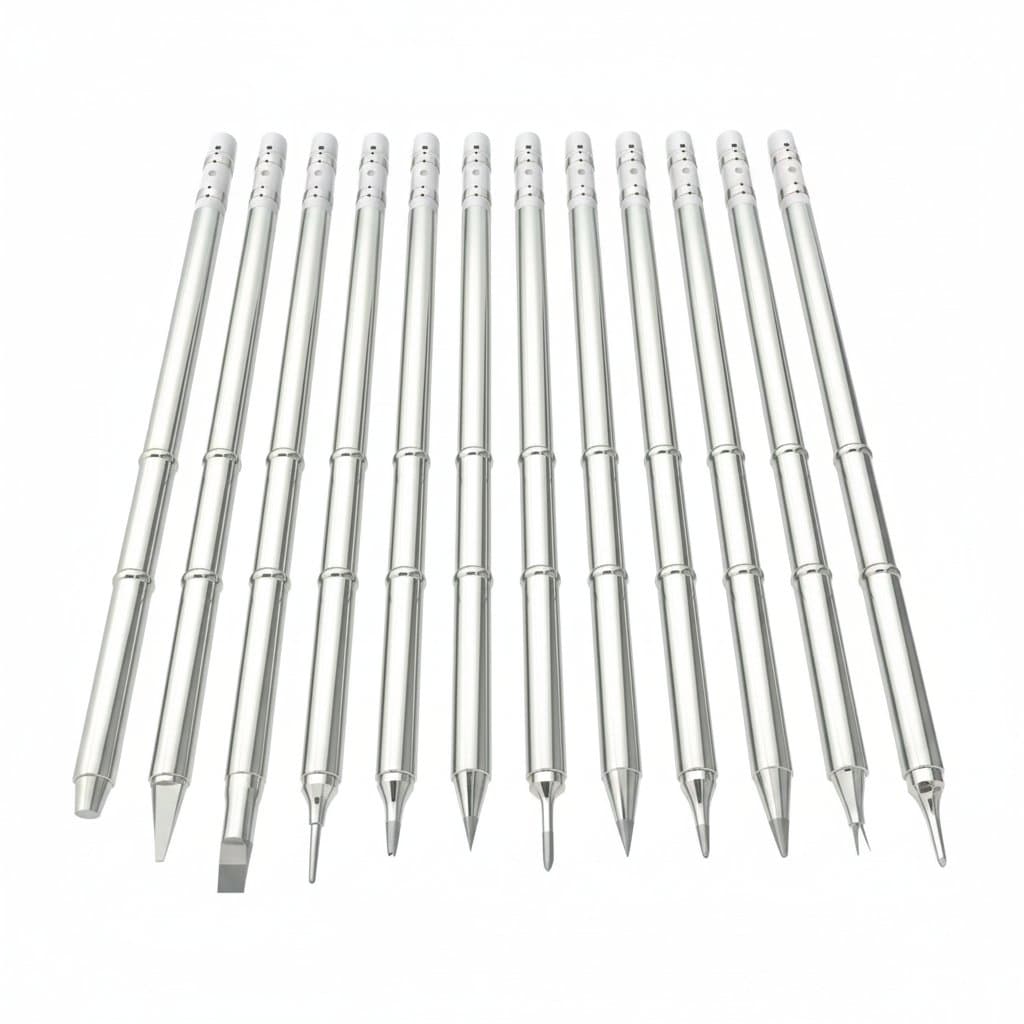
Grind longitudinally, with the grinding marks running along the electrode rather than around it. Circumferential marks make the arc wander because the current has to jump across the ridges.
For DC work on steel, grind a point with a length of about two to two and a half times the diameter. A sharper taper concentrates the arc for fine work; a blunter one carries more current.
For AC on aluminium, run a slightly blunted or balled end. On a modern inverter a truncated point works well and gives better arc control than the fully balled tip that old transformer machines needed.
Use a dedicated wheel or a diamond wheel. Grinding tungsten on the same wheel as steel contaminates the electrode and the arc will spit.