Reading a grinding wheel marking
Every bonded wheel carries a five-part code. Read it in order and it tells you what the wheel is made of and how it will behave.
The grade letter is the one most people ignore and it matters most. It describes how tightly the bond holds the grit, not how hard the abrasive is. A soft grade releases blunt grit and keeps cutting, which is what you want on hard material. A hard grade holds grit longer, which suits soft material that would otherwise wear the wheel away.
| Position | Meaning | Common values |
|---|---|---|
| 1. Abrasive | What cuts | A aluminium oxide, C silicon carbide, Z zirconia, CBN, D diamond |
| 2. Grit | Particle size | 16 to 24 coarse, 36 to 60 medium, 80 to 120 fine, 150+ very fine |
| 3. Grade | Bond hardness | A to H soft, I to P medium, Q to Z hard |
| 4. Structure | Spacing of grit | 1 to 8 dense, 9 to 15 open |
| 5. Bond | What holds it | V vitrified, B resinoid, R rubber, M metal, S silicate |
Grinding wheel types by shape
Type numbers describe the physical shape and where the wheel is meant to contact the work. Using a wheel off its intended face is one of the more common ways they break.
| Type | Shape | Used for |
|---|---|---|
| Type 1 | Straight wheel | Bench and surface grinding, on the periphery only |
| Type 27 | Depressed centre | Angle grinder, grinding at 15 to 30 degrees |
| Type 28 | Depressed centre, saucer | Angle grinder, flatter approach |
| Type 41 | Flat cut-off | Cutting only, never side loading |
| Type 42 | Depressed centre cut-off | Cutting with clearance for the guard |
| Type 6 / 11 | Straight cup / flaring cup | Tool and cutter grinding on the face |
Choosing abrasive and grade for the material
Aluminium oxide for steel and steel alloys. Silicon carbide for cast iron, non-ferrous metals, stone and carbide, because it is harder but more brittle and shatters rather than dulling. Zirconia for heavy stock removal on steel where the wheel takes a beating.
The general rule on grade is hard wheel for soft material, soft wheel for hard material. It reads backwards until you remember that the grade describes bond strength: grinding hardened steel blunts grit quickly, so you want a bond that lets the blunt grit fall away and expose fresh edges.
| Job | Abrasive | Grit | Grade |
|---|---|---|---|
| Rough grinding mild steel | A | 24 to 36 | N to R |
| Grinding hardened tool steel | A | 46 to 60 | H to K |
| Sharpening HSS tooling | A | 46 to 60 | K to M |
| Grinding cast iron | C | 24 to 36 | K to N |
| Grinding aluminium | C | 24 to 36 | J to L |
| Grinding carbide | D or CBN | 100 to 220 | Resin bond |
Maximum safe speed
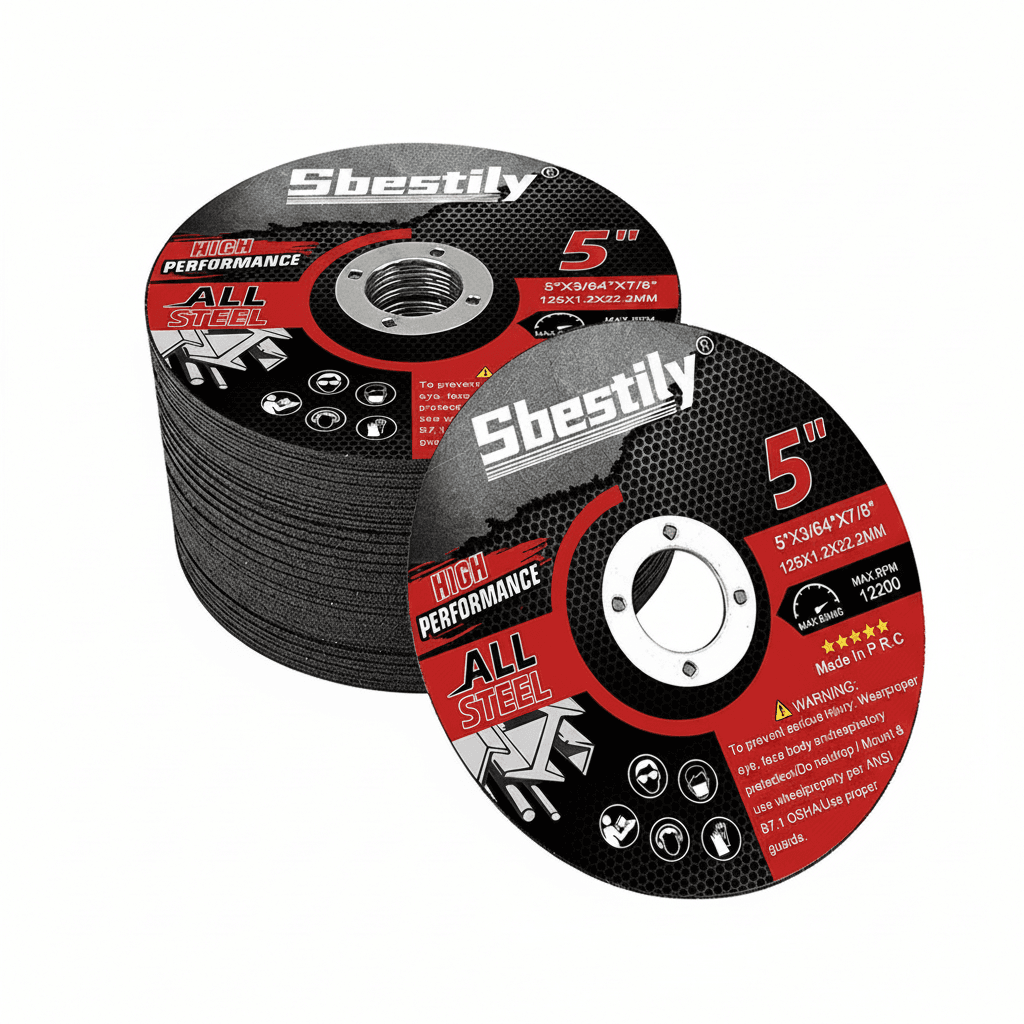
Every wheel carries a maximum rpm and a maximum surface speed on its blotter. Never fit a wheel rated below the free speed of the machine, and never fit a smaller wheel to a faster machine on the assumption that it will be fine.
Surface speed in feet per minute is wheel diameter in inches times pi times rpm, divided by 12. A 7 inch wheel at 8,500 rpm runs at about 15,600 sfm, which is why 7 inch angle grinder wheels are rated far higher than a bench wheel of the same diameter.
Ring-test a vitrified wheel before fitting: hang it on a pin and tap the side with a light non-metallic object. A sound wheel rings, a cracked one thuds. Resinoid and reinforced cutting discs do not ring and cannot be tested this way, so inspect them visually and replace anything chipped.