
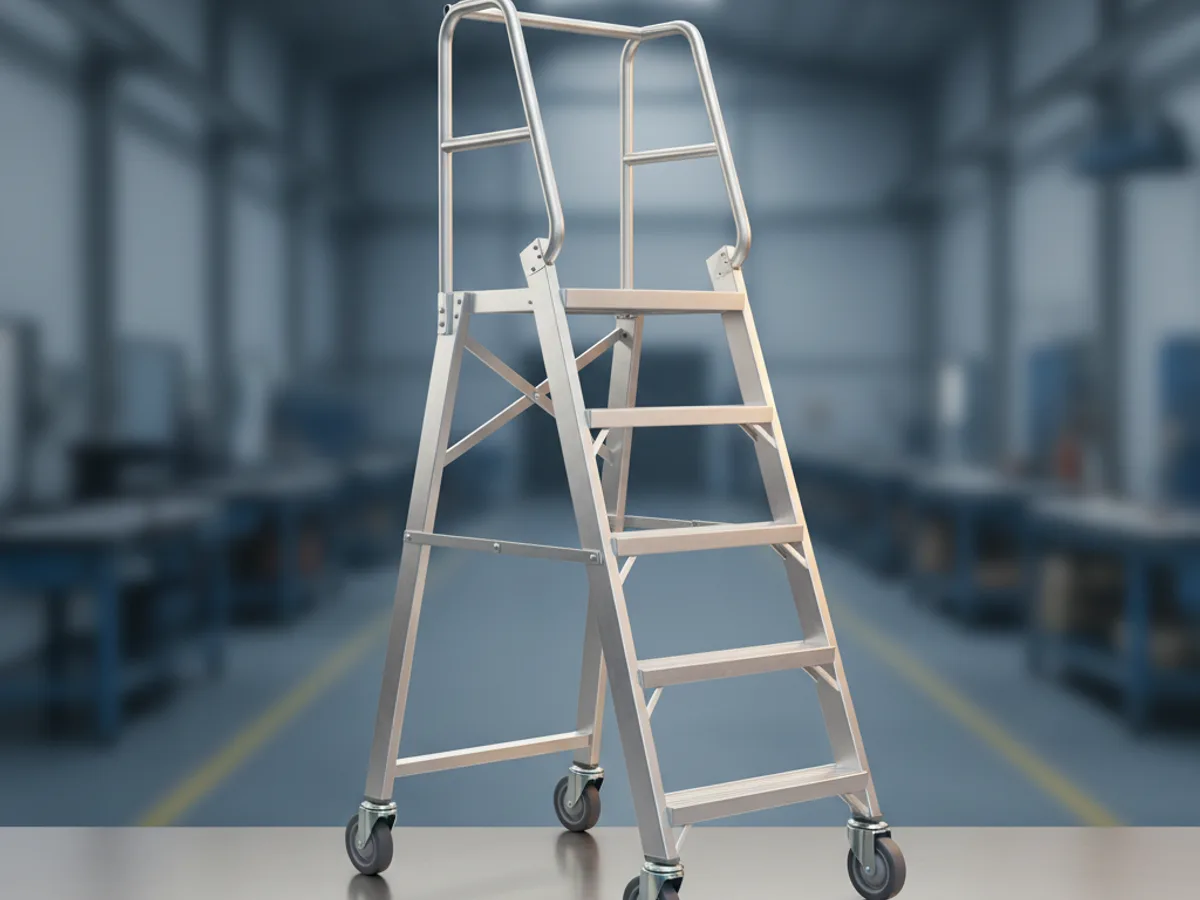


Access equipment against a working platform
The distinction the regulations draw is between reaching a place and working in it. Climbing to change a lamp is access. Standing at height fitting brackets, wiring, or painting for half an hour is work at height, and a ladder makes it harder than it needs to be.
A platform ladder or mobile steps provide a flat standing surface with a handrail or guardrail around it. The user can face the work, use both hands, put tools down, and turn without thinking about balance, which removes the actual cause of most falls rather than warning people about it.
The practical test is simple. If the task needs both hands, or takes more than a few minutes, or requires reaching sideways, the ladder is the wrong equipment. Platform steps cost more than a ladder and considerably less than a fall.
| Task | Equipment | Why |
|---|---|---|
| Brief access, one hand free | Ladder, three points of contact | Short duration and light work only |
| Working at height with both hands | Platform steps with guardrail | Removes the balance problem |
| Repeated picking in a warehouse | Rolling ladder with retracting castors | Moves easily, locks under load |
| Long or high level work | Tower or powered platform | A ladder is out of its range |
Rolling ladders and how the castors work
Warehouse rolling ladders need to move easily when empty and to be completely immobile when someone is on them, and the mechanism that achieves this is spring loaded castors.
With no weight on the ladder the springs hold the castors down and it rolls. As soon as someone steps on, the weight compresses the springs, the castors lift clear and the ladder settles onto rubber feet or a floor lock. The user does not have to remember to do anything, which is precisely why it works.
Check that mechanism as part of the pre use inspection. Seized springs or castors clogged with debris can leave the ladder standing on its wheels under load, which is a ladder that rolls away as someone climbs it. The floor matters too, since these are designed for a level, hard surface.
Duty rating, class and what the load includes
Ladders sold for work are rated for professional or non professional use under the current European standard, which replaced the older class system. The professional rating covers trade use and is the one to look for on anything that will be used regularly for a living.
The load rating is a total, not a body weight. It has to cover the person, their clothing and boots, the tools they carry up, and any materials, and that total climbs faster than people expect once a tool belt and a box of fittings are involved.
Working height figures also need reading carefully. Manufacturers usually quote a reach height that assumes an average person standing on a specified rung, not the height of the top of the ladder. Compare platform height instead, which is unambiguous.
Setting up, telescopic ladders and inspection
A leaning ladder wants roughly one unit out for every four units up, which puts it at about seventy five degrees. Too steep and it can topple backwards, too shallow and the feet slide. Secure it at the top where possible, and never stand it on soft or uneven ground without levelling.
Telescopic ladders pack away well and demand a specific discipline: every section must be fully extended and locked, and the indicators on each rung must all show engaged. A section that has not latched collapses under load. On retraction, keep fingers clear of the stiles, because the sections come down with real force.
Inspect before every use and formally at intervals, with a record. Bent or dented stiles, cracked welds, damaged or missing feet, seized locks and any impact damage put a ladder out of service. Aluminium hides damage well, so run a hand along the stiles rather than relying on a glance, and never repair a structural component with a bolt through it.