



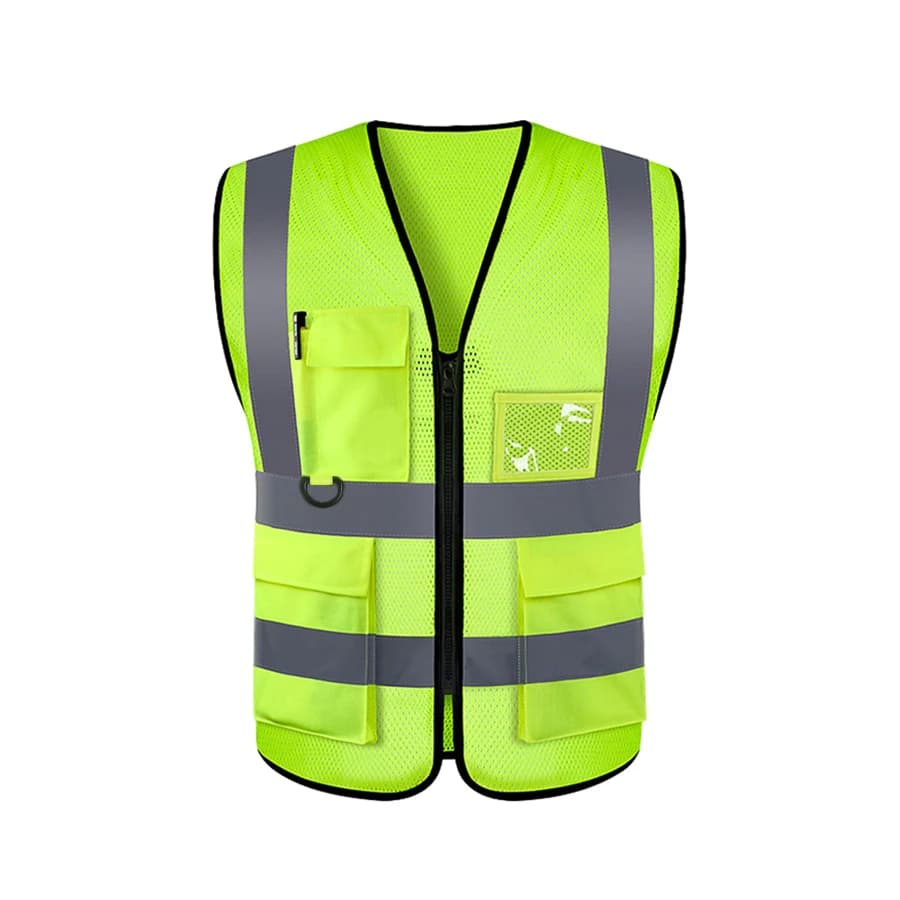

Fluorescent and retroreflective do different jobs
The bright yellow or orange background is fluorescent. It absorbs ultraviolet, which is present in daylight even under cloud, and re-emits it as visible light, so the fabric appears brighter than its surroundings. That effect is what gets someone noticed at dawn, at dusk and against a dull site background. It does almost nothing in the dark, because there is no ultraviolet to work with.
The silver bands are retroreflective. Their microstructure returns light along the path it arrived on, so a driver with headlights sees the bands light up while an observer standing to one side sees very little. That is exactly the behaviour you want at night on a road, and it explains why a vest with plenty of fluorescent fabric but no tape is close to invisible in headlights.
Because they cover different conditions, the two are not substitutes. A garment intended for genuine work near traffic needs both, arranged so the wearer is recognisable as a person from any angle rather than as a floating stripe.
| Condition | Fluorescent fabric | Retroreflective tape |
|---|---|---|
| Bright daylight | Working, main effect | Little effect |
| Overcast and dusk | Working, strongest advantage | Minor effect |
| Darkness, no headlights | Not working | Not working |
| Darkness with headlights | Not working | Working, main effect |
Classes, and why the area of material is the point
High visibility clothing in the UK and Europe is classified under EN ISO 20471, and the class is decided by how much fluorescent background and retroreflective tape the garment carries. Class 1 has the least, Class 3 the most, and a Class 3 garment cannot usually be a simple waistcoat because it needs sleeves to reach the required area.
The class is chosen from the risk, not from preference. Work close to fast moving traffic and low light generally calls for the highest class available; a warehouse yard at walking pace is a different judgement. A vest worn over a dark coat also loses whatever the coat covers, so the outermost layer is the one that has to carry the rating.
We list what the seller declares for each item. Where a specific class or standard matters for your site, check for the mark on the garment label itself rather than relying on a listing description, because that label is what an inspector will look at.
Mesh, solid fabric and pockets
Mesh vests move air and are far more comfortable over a hot shift or over other workwear. The trade is durability and, on cheaper garments, a slightly smaller effective area of fluorescent material because of the open weave. Solid polyester or Oxford fabric wears better against tools and rough edges and holds its colour longer, at the cost of being warmer.
Pockets are worth thinking about rather than maximising. Chest pockets with flaps keep a phone and a pen usable without sitting on top of the reflective bands. Large low patch pockets that bulge sit exactly where the tape needs to be flat and can shadow it.
Closures divide into hook and loop, zip and press stud. Hook and loop is quick and adjusts over bulky layers, and it collects dust and thread until it stops holding. A zip is more secure and lasts better, and a full length zip on a vest that is put on and taken off constantly is slower. Choose for how often it is worn rather than for the specification sheet.
Washing, wear and when to bin it
High visibility performance is consumable. Repeated washing gradually dulls the fluorescent dye and lifts the edges of the retroreflective tape, and manufacturers state a maximum number of wash cycles on the label for exactly that reason. A vest that has been through far more than its rated cycles may still look acceptable in daylight and have lost most of its night performance.
Ingrained dirt has the same effect and is quicker. A layer of dust or oil over the tape stops it returning light, which is why a filthy vest is a hazard rather than a badge of hard work. Wash it within the label instructions, and do not use fabric softener, which coats the tape.
Replace on evidence rather than on a calendar. Fading of the background against a new garment, tape that is cracked, peeling or no longer bright under a torch beam held beside your eye, or any tear across a reflective band, all mean the garment has stopped doing the job it is worn for.