

Steel, aluminium or moulded plastic
Steel is what workshop chests are made of because it takes the load and the abuse, and because it is heavy enough to stay where it is put. It rusts where the paint is chipped, which matters in a damp van rather than in a dry unit.
Aluminium, usually in a diamond plate or chequer finish, is the standard for truck bed and van boxes. It gives most of the strength at a fraction of the weight and does not rust, at the cost of denting rather than springing back and of being easier to attack with a crowbar.
Moulded plastic dominates portable cases. Modern polypropylene shells are tough, they do not mark paintwork or floors, and they can be moulded with the interlocks that modular systems rely on. The trade is that a plastic case flexes under a heavy load and its hinges and catches are the first thing to fail.
| Use | Material | What to check |
|---|---|---|
| Workshop, stays put | Steel chest or cabinet | Drawer slides and per-drawer load rating |
| Van or truck bed | Aluminium | Weather seal, lock quality, mounting points |
| Carried to the job | Moulded plastic | Catch and hinge quality, interlock system |
| Site security | Steel site box | Hasp design and whether it can be bolted down |
Drawer slides and the load rating that matters
Drawers are where cheap and good separate. Friction slides, where the drawer runs on folded steel, are fine when empty and stick and tilt once loaded, which is exactly when you want them working. Ball bearing slides cost more and keep running smoothly with a drawer full of sockets.
Look for a stated load rating per drawer rather than for the total capacity of the cabinet. A chest quoted at a large total is often assuming an even spread nobody achieves; in practice one drawer takes the impact sockets and does all the suffering.
Full extension is worth paying for on deep drawers, because a drawer that only opens two thirds hides its back third for the life of the cabinet. Check the drawer bottoms as well: a thin bottom on a wide drawer bows under weight and eventually fouls the drawer beneath it.
Stackable systems are a one-time decision
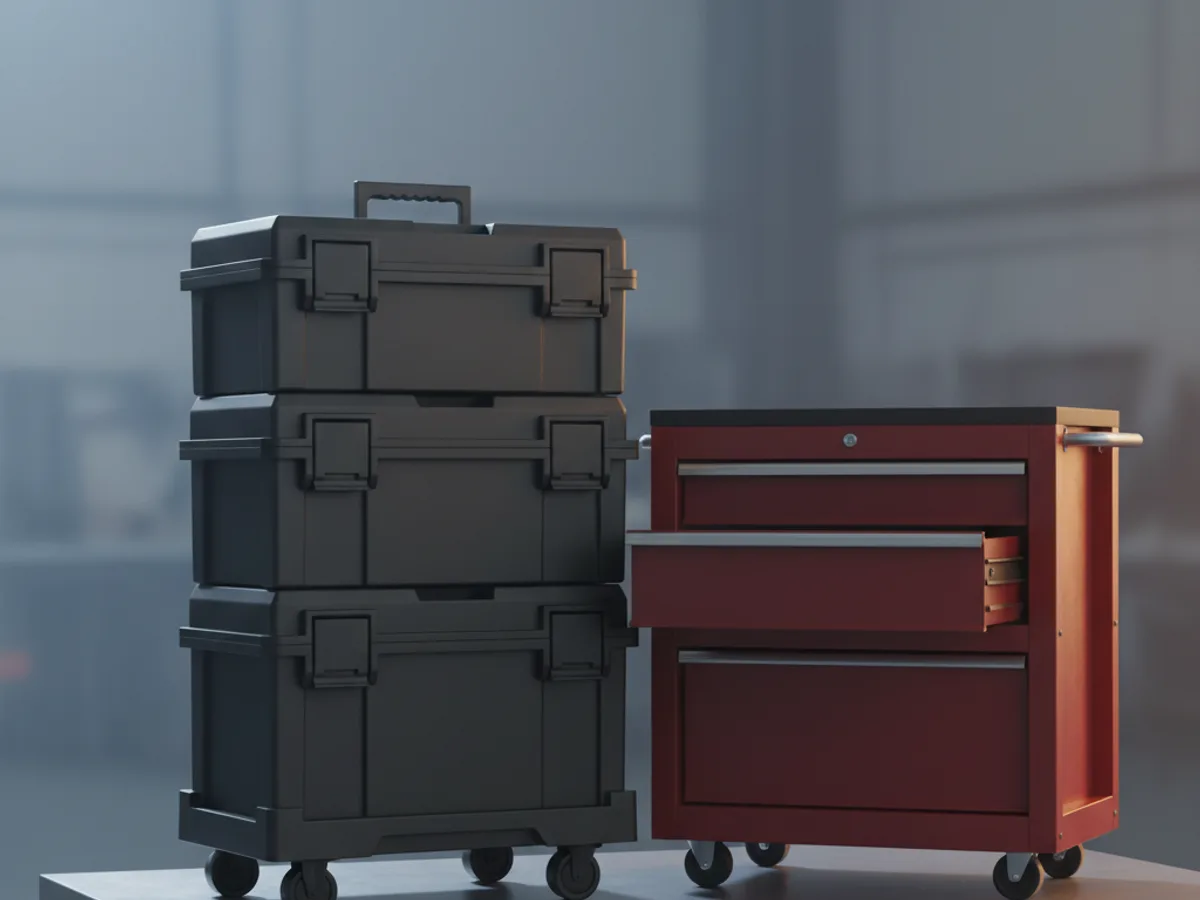
Interlocking modular boxes solve a real problem: a stack that moves as one unit on a single wheeled base, which is far quicker than three trips with separate cases. The catch is that the interlock is proprietary, so the system you buy into is the system you are in.
That makes the first purchase the important one. Check that the range includes the pieces you will want later, a deep box, a drawer unit, an organiser for small parts, and a wheeled base rated for the stack height you intend, rather than buying the cheapest two boxes and discovering the range stops there.
Check the wheeled base and the tow handle honestly. A tall stack of loaded boxes is heavy and top heavy, and small hard wheels that are fine on a smooth workshop floor are useless on a rutted site. Larger wheels and a handle that locks upright make the difference on real ground.
Locks, seals and what actually keeps tools
Most tool box locks are deterrents rather than barriers. A single central latch on a long lid can be sprung at the far end, which is why boxes with a lock at each end, or with a full length piano hinge on the inside, resist a lot better. On anything left in a vehicle, how the box is fixed down matters more than the lock: a box that can be carried away whole makes its lock irrelevant.
Weather sealing is the other half. A rubber gasket around the lid is what keeps a truck box dry, and it only works if the lid closes evenly along its length, so a warped lid or a bent hasp is a leak. Check that any drain path is clear rather than sealed, because condensation forms inside a metal box even when nothing gets in.
For a case that travels, the catches take the punishment. Metal catches on a plastic case, or at least metal reinforcement at the pivot, last far longer than a moulded tab, and a case that pops open when it falls off the tailgate has failed at the only job that mattered.