
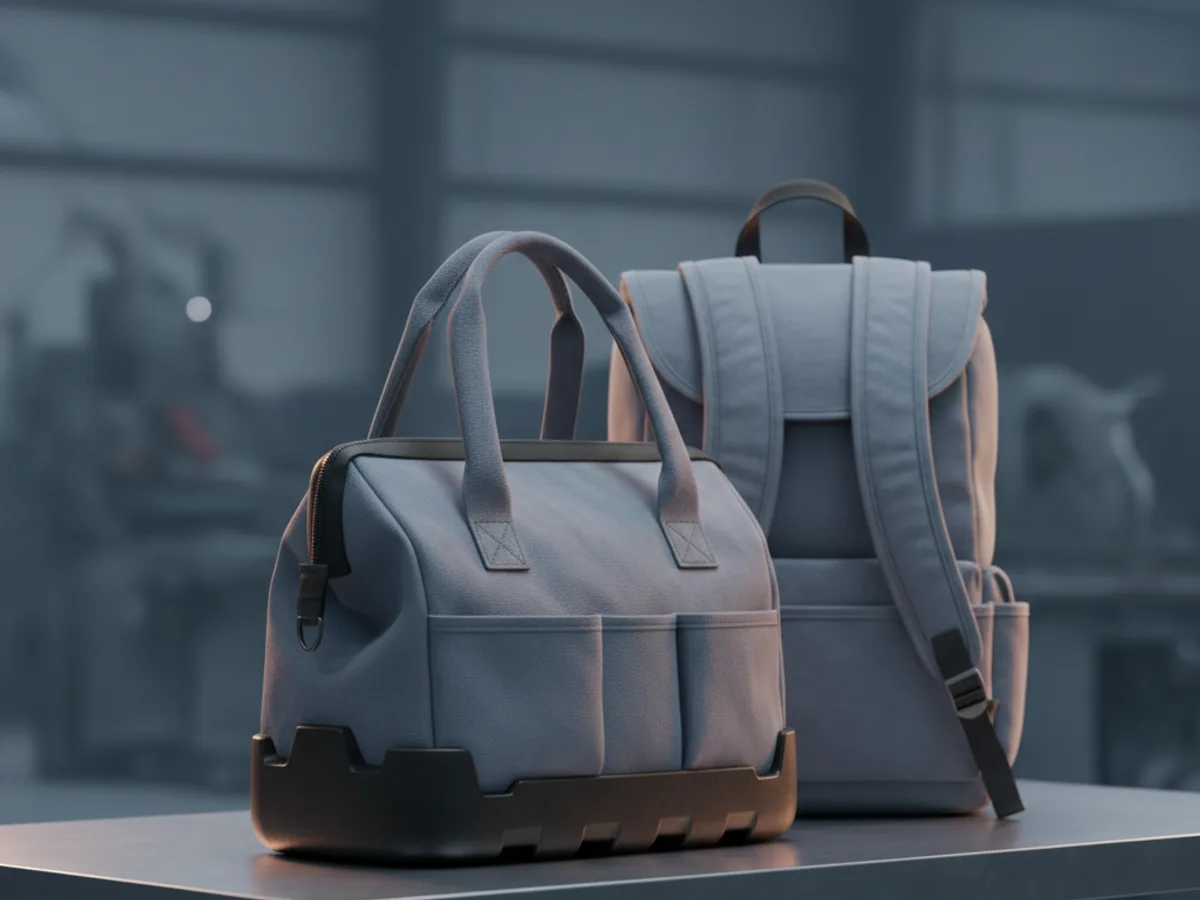


The base is the specification that matters
A moulded rubber or hard plastic base keeps the contents off wet ground, resists abrasion when the bag is dragged, and holds the bag open so tools go back in. A fabric base with a stiffener does none of those things for long.
Watch how the base joins the body. A base stitched on through the fabric puts the stitching where the abrasion is, and that seam is usually the first failure. A moulded base that wraps up the sides protects the seam by keeping it clear of the ground.
Fabric weight is quoted in denier, and higher is heavier and more abrasion resistant. It is a real number and a secondary one: a heavy fabric bag with a stitched fabric base still fails at the base, and a moderate fabric bag with a proper moulded bottom lasts.
| Type | Suits | Trade-off |
|---|---|---|
| Open tote | Fast access, one trade, short jobs | No security, no weather protection |
| Closed holdall | Mixed kit, van storage | Slower to find things |
| Backpack | Ladders, stairs, hands free | Must come off to reach anything |
| Rolling bag | Heavy kit over smooth ground | Wheels are useless on site rubble |
Open, closed, backpack or wheels
An open top tote is the fastest to work out of and the worst in rain, and it offers nothing if the bag is left unattended. For a first fix electrician moving around one building it is often exactly right, and for a bag that lives in the back of a van in all weathers it is not.
A backpack changes what jobs are possible. Both hands free on a ladder or a stairwell is a genuine safety difference rather than a convenience, and the cost is that the bag has to come off the back every time something is needed, which is why they suit work with fewer, longer stops.
Rolling bags carry more weight without carrying it, provided the ground cooperates. Across a car park or a finished floor they are excellent. Across rubble, gravel or a stairwell they are heavier than the bag they replaced, since the wheels and frame are dead weight the moment they stop rolling.
Pockets, and the point of them
A bag that is one large space holds the most and gives the tool back last. Pockets cost capacity and return the time, because a tool that has a place gets put back in it and is found without emptying the bag onto the floor.
The useful arrangement puts the frequently used tools in outside pockets where they are reached without opening anything, and the bulk in the main compartment. Internal elastic loops hold screwdrivers and pliers upright rather than letting them settle to the bottom.
Buying a bag with a tool set included is a reasonable way to start and rarely a good way to buy tools. The bag in those sets is generally sized to the kit rather than to a working day, and the tools are chosen to hit a price. Sets are worth it where the tools are genuinely ones you would have bought.
What a full bag actually weighs
Nobody publishes the sensible loaded weight of a tool bag, and it is the number that decides whether it gets carried or dragged. A large holdall filled with hand tools, a couple of cordless tools and consumables reaches a weight that is a manual handling problem in its own right, particularly carried one handed up stairs.
Two medium bags beat one large one more often than people expect. They split by trade or by task, they can be carried one in each hand which balances the load, and only the relevant one gets taken up a ladder.
Handles are where an overloaded bag gives way. Look for handles that pass under the base or are riveted through rather than stitched to the side panel, and for a shoulder strap with a wide pad, since a narrow strap under real weight is unpleasant within a hundred metres.