
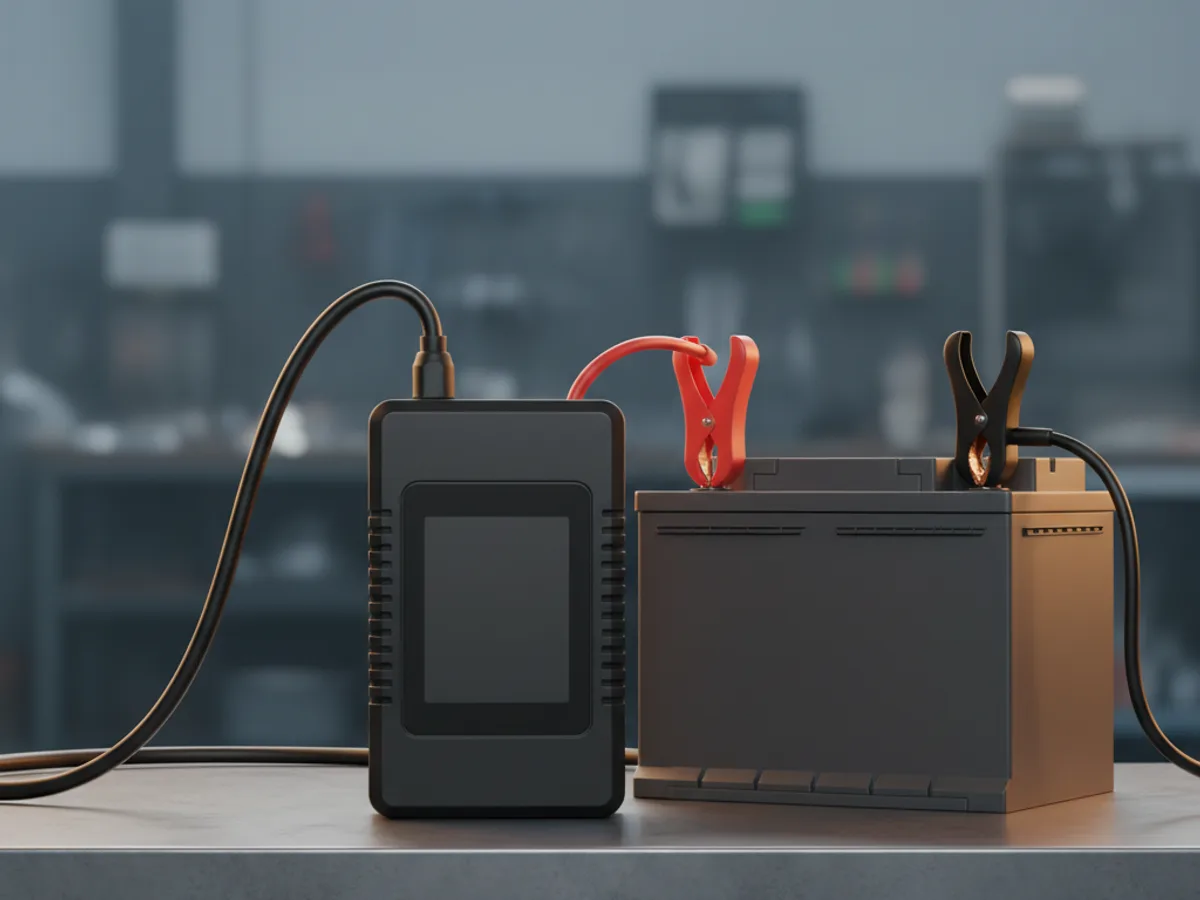


What multi stage charging actually does
The first stage delivers as much current as the charger can while the battery voltage is low, which does most of the work. As the battery fills, its voltage rises and the charger switches to holding a constant voltage while the current it accepts falls away naturally. That taper is what fully charges a lead acid battery without boiling it.
The final stage is maintenance, sometimes called float or trickle. The charger drops to a lower holding voltage that replaces self discharge and nothing more, which is why a smart charger can be left on a vehicle over winter and an old unregulated charger cannot.
That is the whole case for a smart charger over a plain transformer one. The old type keeps pushing regardless, and a battery left on it gasses, loses electrolyte and is damaged by the thing meant to look after it.
| Stage | What happens | Why |
|---|---|---|
| Bulk | Maximum current, voltage rising | Restores most of the capacity quickly |
| Absorption | Voltage held, current tapering | Completes the charge without gassing |
| Float or maintenance | Lower holding voltage | Replaces self discharge, safe to leave connected |
| Recovery, where offered | Controlled higher voltage pulses | Attempts to recover a sulphated battery |
Chemistry is a setting, not a detail
Flooded lead acid, AGM and gel all want slightly different voltages, and a charger with a mode for each gets closer to the right one. Gel in particular is damaged by the higher absorption voltage that suits a flooded battery, so using the wrong mode shortens its life quietly rather than obviously.
Lithium iron phosphate is a different matter entirely. It charges to a different voltage, does not want a float stage held indefinitely in the same way, and must never be given the high voltage desulphation pulses some chargers use on lead acid. A charger without a lithium mode should not be pointed at a lithium battery, whatever the nominal voltage says.
Set the mode before connecting rather than after. Many chargers begin as soon as they see a battery, and a few seconds in the wrong profile is usually harmless while a full cycle is not.
Sizing the charger to the battery
Charge current is quoted in amps and battery capacity in amp hours, and a widely used rule of thumb is to charge at around a tenth of the capacity figure. A 70 amp hour car battery is therefore comfortable at roughly 7 amps, which fills it overnight without stressing it.
Going much higher shortens battery life through heat, and going much lower simply takes longer, which matters only if you are in a hurry. A small maintainer of an amp or two is not a fast charger and is not meant to be; it exists to hold a battery that is already charged.
For a workshop, one charger able to cover both is worth more than two specialised ones. Look for a unit whose current can be selected rather than fixed, and check it covers 24 volt if commercial vehicles or plant are in the mix, because a 12 volt only charger is a frustrating limit to discover later.
Recovery modes, and what they can and cannot do
Sulphation is the normal ageing process of a lead acid battery left partly discharged: lead sulphate crystals form on the plates and stop taking part in the chemistry. Recovery or desulphation modes apply controlled higher voltage pulses to try to break those crystals down.
It sometimes works, on a battery that is moderately sulphated and otherwise sound. It does nothing for a battery with a shorted cell, a physically damaged plate or lost electrolyte, and no amount of repeating the cycle changes that. A battery that will not hold charge after one recovery attempt is finished.
Charge in a ventilated space and check the terminals are clean before connecting. Lead acid batteries give off hydrogen while charging, which is why the connection is made at the battery before the charger is switched on, and broken after it is switched off, so that no spark happens at the terminal.