
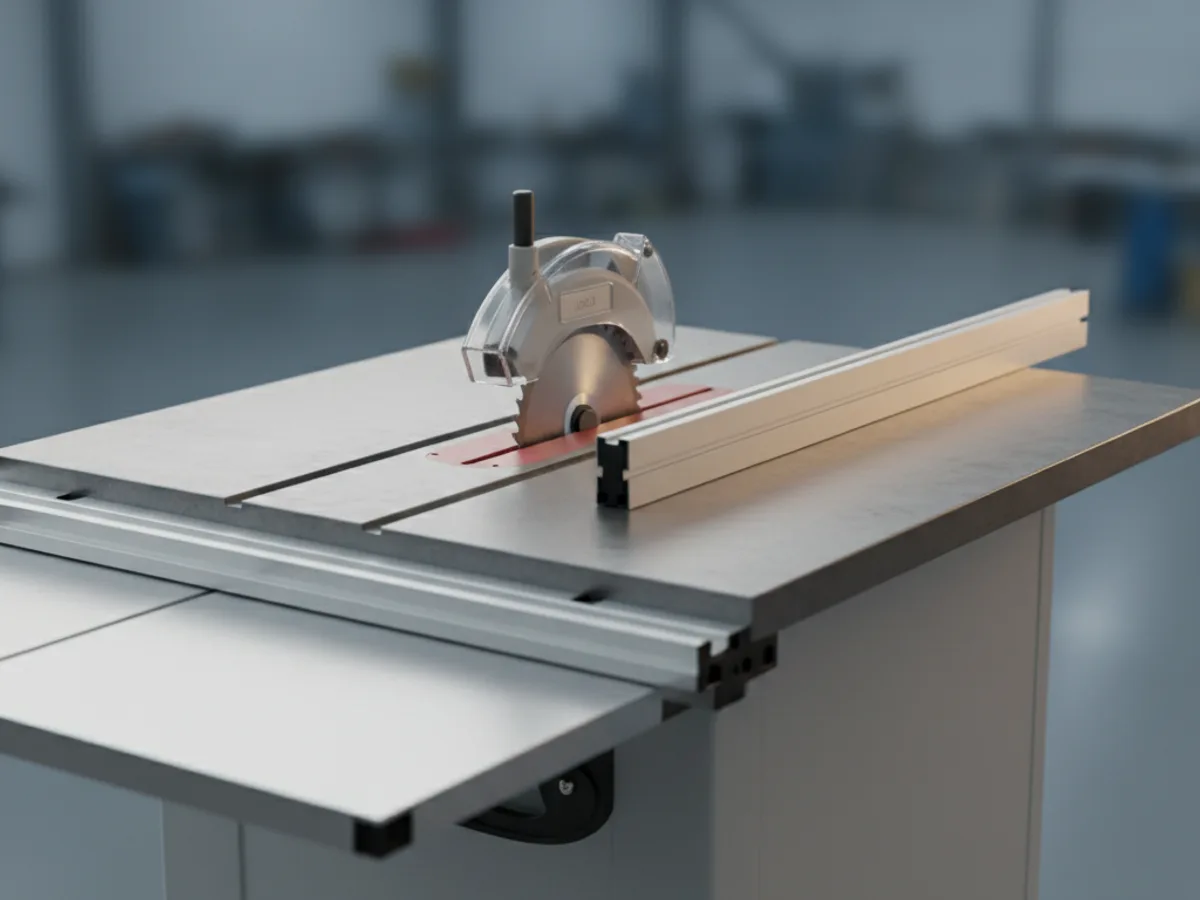


Site saw, cabinet saw and sliding carriage
A site saw is light, folds onto a stand and goes in a van. It cuts accurately enough for second fix work and it is small, so a full sheet of ply is unsupported on three sides and difficult to control alone.
A cabinet saw is heavy, stays where it is put and cuts far more accurately because the mass damps vibration and the trunnions are rigid. It still asks the operator to push the workpiece past the blade against a fence.
A sliding table saw adds a carriage that carries the workpiece past the blade instead. The material rides on the moving table, so a sheet is supported and guided rather than balanced and pushed, and the operator stands beside the cut rather than behind it. For sheet goods that is a difference in both accuracy and safety.
| Saw | Suits | Limitation |
|---|---|---|
| Site saw | Portable second fix work | Little support for full sheets |
| Cabinet saw | Accurate solid timber work | Heavy, fixed in place |
| Sliding table saw | Sheet goods and panel work | Needs floor space either side |
| Scoring blade fitted | Melamine and veneered board | Extra setup, extra cost |
Where kickback comes from
Kickback happens when the workpiece is caught by the teeth at the back of the blade, which are travelling upward and toward the operator. Timber that closes on the blade behind the cut, or that twists away from the fence, gets gripped by those teeth and thrown.
The riving knife prevents the first case, because it keeps the cut open behind the blade so the two halves cannot pinch. It has to be the correct thickness for the blade and set at the correct distance, and on a good machine it rises, falls and tilts with the blade so it stays in position.
The crown guard on top adds a shield and holds the workpiece down, and anti-kickback pawls bite into timber trying to travel backwards. A short rip fence, one that ends level with the front of the blade, helps with solid timber that closes as internal stress is released. Standing to one side of the line of the blade rather than directly behind it is free.
The scoring blade and clean board edges
Melamine faced board and veneered panels chip on the underside because the blade teeth exit through the face, lifting the brittle surface as they go. No amount of care with a single blade fully solves it.
A scoring blade is a small blade mounted ahead of the main one, turning in the opposite direction and set to cut a shallow groove a millimetre or two deep. The main blade then cuts within a groove that is already severed, so nothing is left to tear out.
Setting it up is exacting. The scoring blade must be exactly the same width as the main blade kerf or slightly wider, and centred on it. Set too narrow and one edge still chips; too wide and there is a visible step. It is a machine with a setup procedure rather than a feature that just works.
Push sticks, blade height and dust
Hands never go near the blade. Push sticks and push blocks exist so that the last stretch of a rip cut is completed by something disposable, and a push stick that has been chewed by the blade has done its job. Keep one hanging on the machine rather than in a drawer.
Set the blade only a little above the workpiece, enough for the gullets to clear. A blade standing high presents more teeth to catch a hand and cuts at a worse angle, and a blade barely above the work throws material forward rather than upward when things go wrong.
Fine wood dust is a genuine health hazard and hardwood dust is classified as a carcinogen. A table saw produces a great deal of it, so connect extraction at the cabinet and at the crown guard where the machine allows both, and treat a dust mask as the last line rather than the first. Never make a cut freehand without the fence or the carriage guiding the work.