
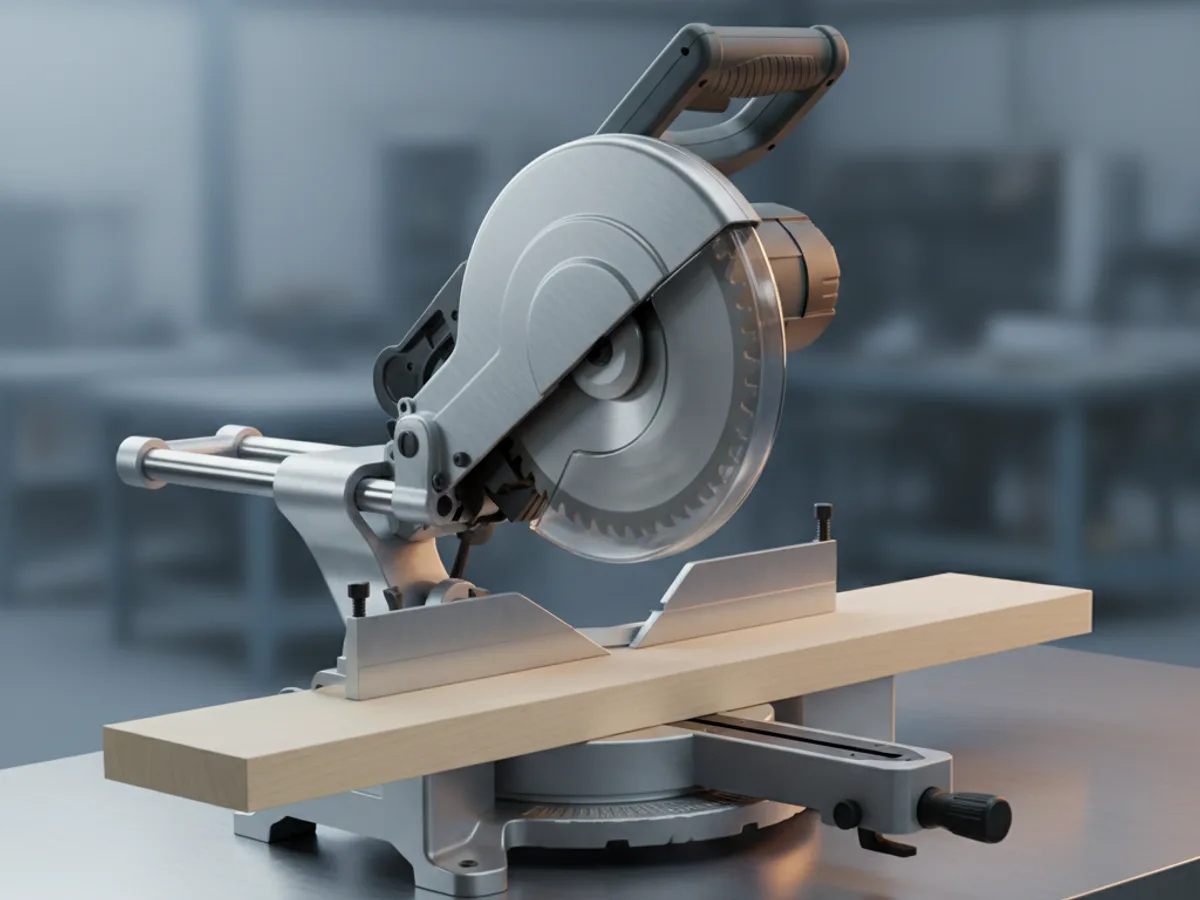

Mitre, bevel, compound, sliding
A basic chop saw drops a blade straight through the work, cutting square. Adding a mitre function lets the head rotate so the cut runs at an angle across the face, which is what a picture frame corner needs.
Adding bevel lets the blade tilt over, cutting an angle through the thickness. A saw that does both at once is a compound mitre saw, and that combination is what skirting, architrave and roofing timber ask for.
A sliding saw puts the head on rails so it can be pulled forward through wide material. Without it the crosscut width is limited to roughly what the blade diameter allows, and with it a saw with a modest blade can cross a wide board. The trade is that the rails need clear space behind the saw, unless the machine uses an articulated arm designed to sit against a wall.
| Feature | Allows | Consider |
|---|---|---|
| Mitre | Angled cuts across the face | Every saw has it |
| Bevel | Angled cuts through the thickness | Single bevel tilts one way only |
| Dual bevel | Tilting both ways | No flipping long skirting |
| Sliding | Crosscut wider than the blade allows | Needs space behind the saw |
Single or dual bevel
A single bevel saw tilts in one direction only. To cut the opposite hand of a bevelled joint you turn the workpiece over and around, which is fine on short offcuts and awkward on a four metre length of skirting in a hallway.
A dual bevel saw tilts both ways, so the piece stays where it is and the saw does the changing. On a first fix or a room full of moulding that saves genuine time and, more importantly, removes a source of error, because every flip is a chance to cut the wrong hand.
For occasional square and simple mitre cuts the extra cost buys nothing. For anyone fitting skirting, architrave or coving regularly it repays quickly, and it is the single upgrade most second fix carpenters say they would not go back on.
The capacity figure that matters is at 45 degrees
Manufacturers quote crosscut capacity at ninety degrees, which is the largest number the saw can produce. Swing the head to forty five degrees and the blade travels diagonally across the work, so the width it can cross falls substantially.
That reduced figure is the one that decides real jobs, because mitred work is exactly where wide capacity is needed. A saw that crosses a wide board square and stops short of the skirting you actually fit at forty five degrees will disappoint on the first day.
Check the vertical capacity as well, meaning how tall a piece can be cut standing against the fence, since tall skirting and coving are often cut that way rather than flat. Compare the figures at the angles you will use rather than the headline pair.
Support, blades and where the hands go
The workpiece must sit flat against the fence and the table along its whole length, with the offcut supported. An unsupported offcut drops as it is severed, pinching the blade, and a long piece hanging off the end lifts the near end off the table so the cut wanders.
Blades for mitre saws should have a negative rake, meaning the teeth lean away from the direction of cut, so the blade does not grab the work and climb. Fitting a positive rake ripping blade makes the saw snatch the workpiece downward, which is exactly what you do not want on a machine you pull toward yourself.
Keep both hands well clear of the blade path and never cross an arm in front of the head to hold work on the far side. Clamp instead. Let the blade reach full speed before entering the cut, let it stop before lifting, and be aware that a short offcut trapped between blade and fence is launched rather than dropped.