
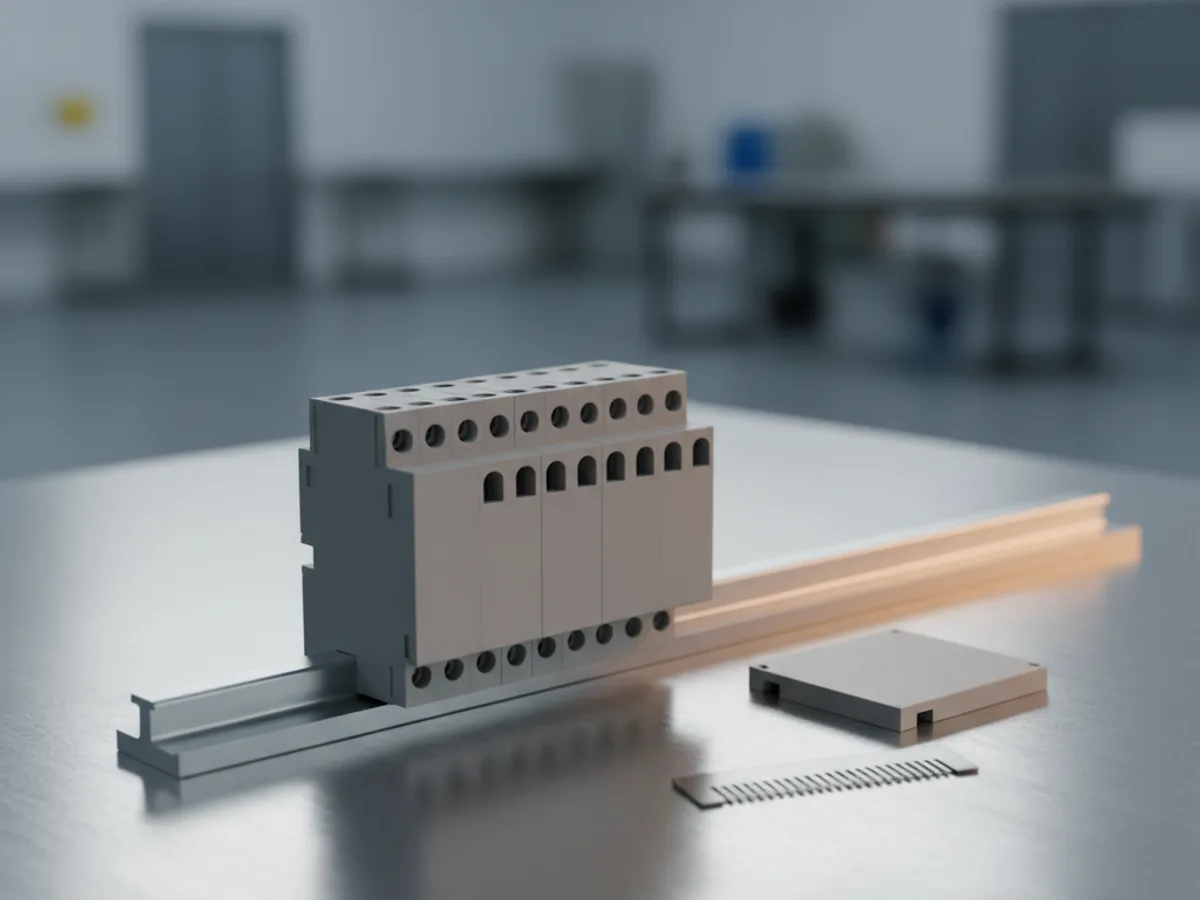


Screw clamp or push-in spring
A screw clamp block presses the conductor with a screw and a clamping yoke. It is familiar, it takes a wide range of conductor sizes in one terminal, and it can be re-tightened. The weakness is that it relies on that torque staying put: vibration and the slow cold flow of copper under pressure both loosen it, which is why panels that move get periodic re-torquing.
A push-in spring block uses a spring to hold the conductor against a busbar. There is no torque to set and none to lose, so it holds through vibration and needs no maintenance, and wiring a panel is far quicker because a ferruled conductor pushes straight in. The trade is a narrower conductor range per terminal and a lever or tool needed to release.
For anything on a machine, a vehicle or in a plant with vibration, spring clamp is the better engineering choice. For a static cabinet with mixed conductor sizes and occasional changes, screw clamp remains perfectly sound.
| Screw clamp | Push-in spring | |
|---|---|---|
| Holds through vibration | Needs re-torquing | Yes, no torque to lose |
| Conductor range per terminal | Wide | Narrower |
| Wiring speed | Slower | Much faster with ferrules |
| Maintenance | Periodic re-torque | None |
Feed-through is only one of the types
The plain feed-through block joins one conductor to another and is what most of a panel is made of. Beyond that, a fuse terminal puts a fuse carrier in line so a circuit can be protected and isolated at the rail. A disconnect terminal has a knife or lever that opens the link for testing without removing wires.
Ground terminals are different in an important way: instead of an insulated busbar they connect directly to the DIN rail through a metal foot, so the rail itself becomes the earth path. That means the rail has to be properly bonded, and it means a ground terminal cannot be used as an ordinary feed-through.
Multi-level blocks stack two or three connections in the footprint of one, which is how a dense panel fits into a small enclosure. They save width and cost clarity, so they suit repeated identical circuits such as sensor wiring rather than a mixed panel someone will have to trace later.
Jumpers, end plates and end stops
Terminal blocks are open on both sides, so the last block in a row needs an end plate to close it off and keep fingers and tools away from live metal. It is not decorative and a row without one is not finished.
End stops clamp to the rail and stop the row sliding along it. Without them the whole assembly walks under vibration and under the pull of the loom, which loosens connections and eventually leaves blocks hanging off the end of the rail.
Jumper bars, sometimes called comb bridges, link adjacent terminals into a common potential, which is how a shared supply or neutral is distributed without daisy-chaining wire between terminals. Buying the blocks and forgetting the jumpers, plates and stops is the most common way a panel order arrives incomplete.
Rated current, voltage and the housing material
The current rating follows the conductor size the terminal is built for, so a 2.5 square millimetre block is rated for what that conductor carries rather than for anything you can push into it. Voltage rating and the creepage distances that go with it matter as soon as a panel carries more than extra low voltage, and mixing a low voltage block into a mains circuit because it fits is exactly the wrong economy.
Housing material is usually polyamide, and the specification worth reading is the flammability rating. UL94 V-0 is the class that self-extinguishes quickly and does not drip flaming material, which is what belongs in an enclosure full of wiring.
Operating temperature range matters where a panel lives outdoors or beside hot plant. The declared figures in the table below are the sellers own for each listing, and where a rating is load-bearing for your installation it is worth confirming on the product before you rely on it.