
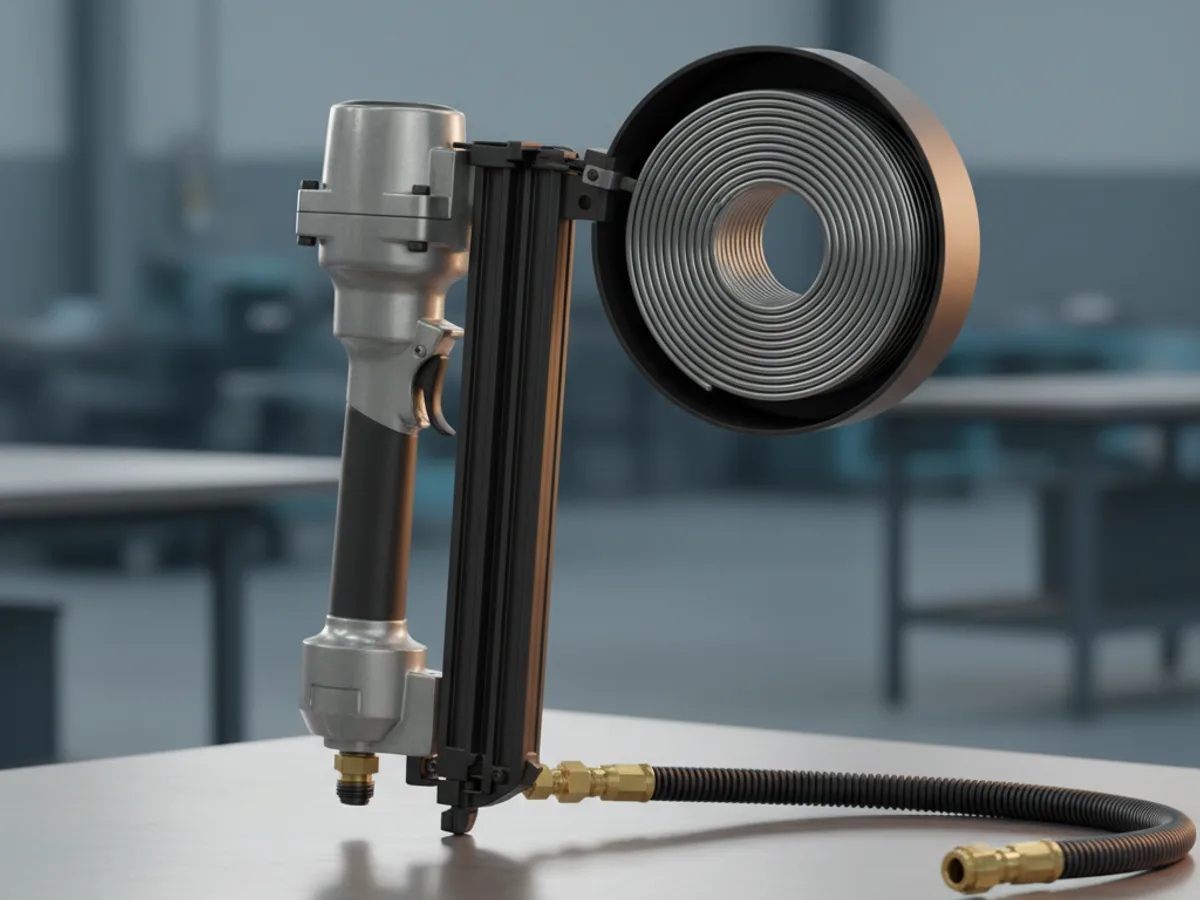


First fix, second fix and coil
First fix or framing nailers drive long, thick nails into structural timber. They are heavy, powerful and leave a substantial head standing proud, which is exactly right for a stud wall and wrong for anything visible.
Second fix nailers drive fine brads or pins that leave a hole small enough to fill and disappear. They have far less power because they do not need it, and using one for structural work produces fixings that will not hold.
Roofing nailers are their own category. They take nails collated in a flat wire coil rather than a strip, which fits hundreds of nails into a compact drum, and drive short nails with wide heads suited to felt, shingle and sheet materials. The coil format is what makes working across a roof practical without constant reloading.
| Job | Gun | Nail |
|---|---|---|
| Studwork and structural timber | Framing, first fix | Long, thick, proud head |
| Architrave, skirting, trim | Brad or pin, second fix | Fine, fills and disappears |
| Felt, shingle, sheet roofing | Coil roofing nailer | Short with a wide head |
| Sheathing and battens | Coil or framing | Depends on the specification |
Collation angle and head shape
Strip nailers hold nails in a straight magazine at a fixed angle, commonly around twenty one degrees or in the low thirties, and the magazine only accepts nails collated at its own angle. Buying the right length and gauge at the wrong angle produces a box that will not load.
The collation material differs too: paper or plastic strips, and wire for coils. Plastic collation leaves small fragments flying as each nail fires, which is a reason for eye protection, and paper collation swells if it gets damp and jams.
Head shape can be a specification issue rather than a preference. Some nailers use clipped head nails, which pack more into a magazine, and some building specifications call for full round head nails in structural work. Check what the job requires before buying either the gun or a pallet of nails.
Sequential and contact firing
The nose of a nail gun has a safety contact that must be pressed against the work before the tool will fire. How that interacts with the trigger is the most important setting on the tool.
In sequential mode the contact must be pressed first and then the trigger pulled, one nail per pull. In contact or bump mode the trigger can be held down while the nose is bounced along the work, firing a nail at each touch. Contact mode is much faster and it is how the classic injuries happen: the gun recoils, the nose touches something on the rebound, and a second nail fires where nobody intended.
Sequential firing is the mode for anything other than repetitive open sheathing, and it should be the default. Never wedge, tape or remove the nose contact, keep the free hand well behind the line of the fastener, and disconnect the air or remove the battery before clearing a jam.
Depth, pressure and power source
Depth of drive is adjusted at the tool and it is worth setting on a scrap piece. A nail driven too deep crushes the timber around it and loses holding power, and on trim it blows out a crater far bigger than the filler will hide. A nail left standing proud has to be finished by hand, which defeats the point.
On a pneumatic gun, pressure also affects drive depth, and both matter: set pressure within the range the tool states and then fine tune with the depth adjuster. A compressor that cannot sustain the air volume shows as nails driving well at first and then progressively standing proud as the tank falls.
Cordless gas and battery nailers remove the hose and the compressor, which transforms work on a roof or in a loft. They are heavier at the nose, cost more per fixing, and the gas versions need fuel cells kept from freezing in winter. For fixed bench or repetitive work a pneumatic gun remains lighter and cheaper to run.