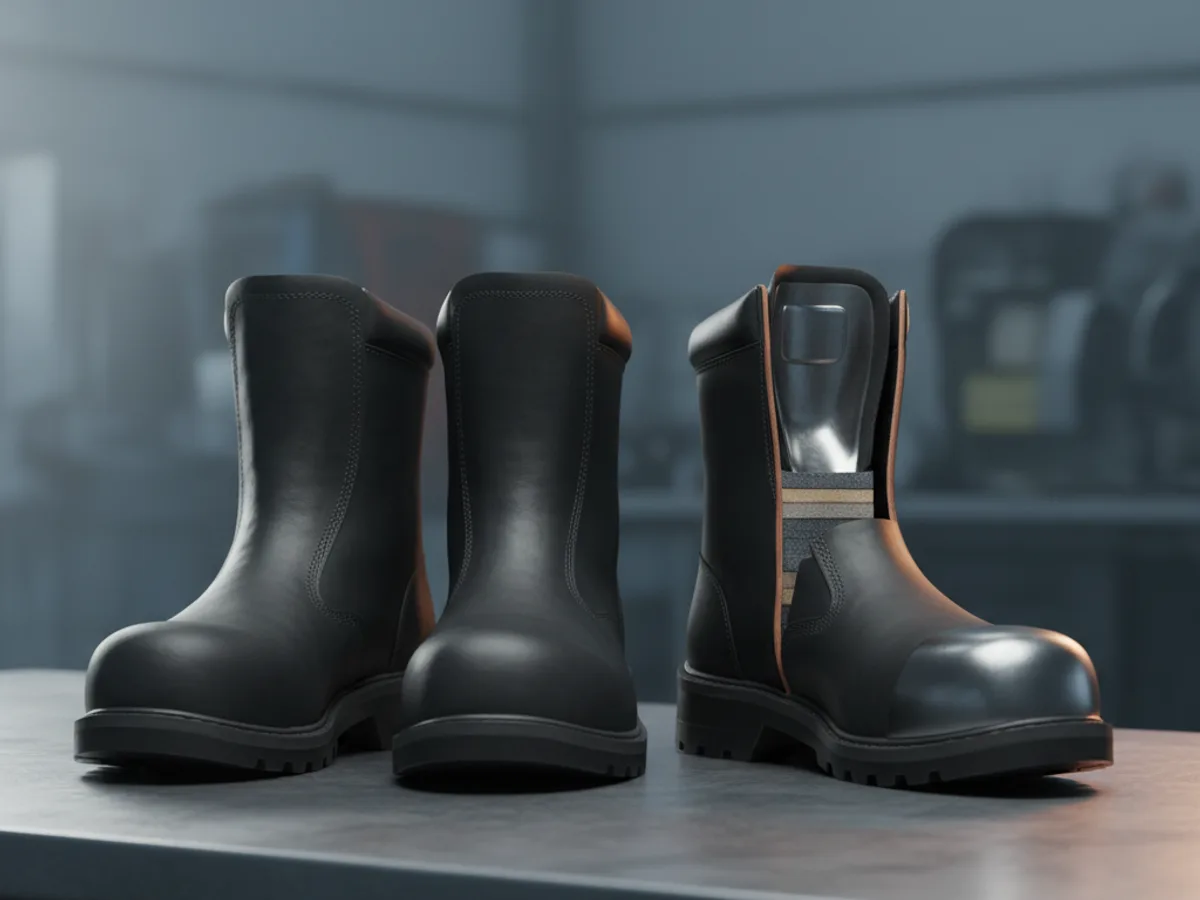


Composite or steel, and what actually differs
Both cap types are tested to the same impact and compression requirement, so on protection alone there is nothing to choose between a certified composite cap and a certified steel one. The differences are practical rather than protective.
Composite is lighter, which is felt over a shift rather than in the shop. It does not conduct, so it stays closer to foot temperature in cold weather and does not draw heat away in the way a steel cap can. And it is non-metallic, which matters for anyone passing through detectors regularly or working around sensitive equipment.
Steel is thinner for the same protection, so a steel cap boot has slightly more internal room in the toe box for the same outside size. It is also generally cheaper. Where weight and temperature do not matter and cost does, steel remains a sensible choice.
| Composite | Steel | |
|---|---|---|
| Impact protection | Same standard | Same standard |
| Weight | Lighter | Heavier |
| Cold and heat transfer | Does not conduct | Conducts |
| Metal detectors | Passes | Sets them off |
| Room in the toe box | Slightly less, cap is thicker | Slightly more |
What the S1 to S3 codes add
Safety footwear in the UK and Europe is classified under EN ISO 20345. The base requirement, SB, is a toe cap tested to 200 joules. Everything above that is a stack of added features, and the letter codes tell you which.
S1 adds a closed heel region, antistatic properties and energy absorption in the seat. S2 adds resistance to water penetration through the upper. S3 adds penetration resistance in the midsole and a cleated outsole. A P suffix means penetration resistance has been added to a lower class. In practice S3 is the general site specification, because it covers the nail through the sole as well as the weight on the toe.
We list what the seller declares for each item. Where a specific class is required for your site, check for the mark stamped inside the boot or on the label rather than relying on a listing description, because that stamp is what an inspector will look for.
Midsole protection is the other half of the job
A toe cap protects against something landing on the foot. It does nothing about standing on a nail, which on a construction or demolition site is the more likely injury. That is what the midsole plate is for, and it is the difference between an S1 and an S3 boot.
The plate comes in steel or in composite textile. A steel plate is thin and very hard to penetrate, but it is a flat sheet that cannot cover the full width of the sole where it curves, leaving a small unprotected margin at the edges. A composite plate covers more of the footprint and is lighter and non-conductive, and it is tested against a slightly different nail.
Neither makes a boot puncture proof. The tests use a specified nail at a specified force, and a longer, thinner or harder object can still get through. The plate reduces a common injury rather than eliminating it.
Fit, uppers and getting the size right
A toe cap does not flex or break in. That makes fit far more important than in ordinary footwear, because if your toes reach the cap they will keep reaching it for the life of the boot. Try boots late in the day when feet have swollen, wearing the socks you actually work in, and check there is room ahead of the longest toe.
Uppers divide broadly into leather and synthetic mesh. Leather is more durable, more resistant to sparks and abrasion, and takes longer to dry. Mesh and synthetic uppers are lighter and considerably cooler, which is why summer safety trainers exist, at the cost of durability and water resistance.
Water resistance is a specification rather than a property of the material. A boot rated for water penetration resistance has been tested as a whole, seams included. Leather alone is not waterproof, and a boot described only as leather is not making that claim.