

Push-in or lever, and which takes stranded wire
A plain push-in connector has a spring cage that a stripped conductor is pushed straight into. It is fast and it holds well, and it is designed around solid conductor. Push fine stranded wire in and the strands splay against the cage entry rather than passing through it cleanly.
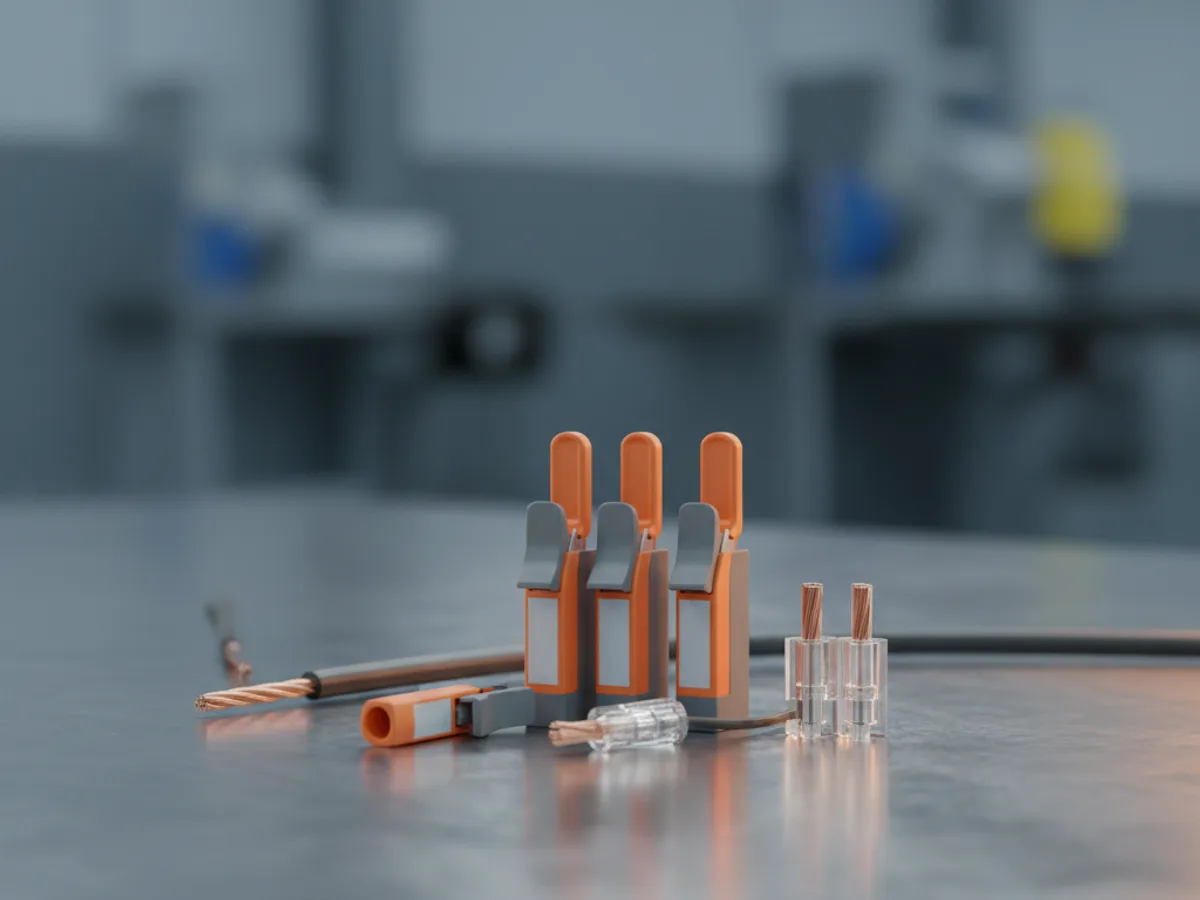
A lever connector solves that. Lifting the lever opens the cage completely, the conductor goes in without resistance, and closing the lever clamps it. That mechanism handles solid, stranded and fine stranded conductor equally, and it can be opened and reused without damaging the wire, which is why it has become the default for anything that might be changed later.
The alternative for stranded wire in a push-in connector is a bootlace ferrule crimped onto the end, which turns many fine strands into one solid pin. That is the correct fix rather than a workaround, and it is what panel wiring does as standard.
| Conductor | Plain push-in | Lever type |
|---|---|---|
| Solid | Yes, straight in | Yes |
| Stranded | Only with a ferrule | Yes, directly |
| Fine stranded | Ferrule required | Yes, directly |
| Reusable | Limited | Yes, open and reuse |
Strip length is a specification, not a guess
Every connector of this type states a strip length, usually printed on the body or moulded into it as a gauge you can hold the wire against. It is not advisory. Strip too little and the conductor does not reach the contact, giving a joint that tests fine and fails under load. Strip too much and bare copper stands proud of the housing, which is a short waiting for something to touch it.
Use the gauge on the connector itself where there is one. Where there is not, the figure is on the packaging or the datasheet, and it is worth cutting one wire to that length and using it as a reference for the rest of the job.
Check the wire is fully home after insertion by pulling on it gently. A conductor that has not passed the spring will come out, and finding that now is considerably better than finding it inside a sealed junction box in a year.
Ratings, and where these connectors may be used
Each connector carries a current rating, a voltage rating and a conductor size range, and all three bind. Exceeding the current rating heats the spring, and a spring that has been heated loses tension permanently, so a connector that has been overloaded is not repaired by reducing the load afterwards.
The housing is usually polyamide and the specification worth reading is the flammability rating. UL94 V-0 self-extinguishes and does not drip flaming material, which is the class that belongs anywhere inside an enclosure or a ceiling void.
These connectors are not a substitute for an enclosure. A connection made in a push-in connector still has to sit inside a suitable box that is accessible, in the same way a screw terminal would. Burying one in a wall or a joist void without a box is the failure that gets found by the next person to look for it.
Where crimp lugs take over
Spring connectors have a ceiling. Above a few square millimetres the spring force needed becomes impractical, and heavy conductors go to a crimped lug bolted to a busbar, a stud or a terminal instead.
A properly made crimp is gas tight, which means the conductor and the barrel are cold welded into effectively one piece of metal with no air path to oxidise. That takes the right die profile for the lug and the right tool, and hexagonal dies are what heavier lugs use.
Tinned lugs are worth the small extra in damp or marine conditions, because bare copper grows a resistive oxide exactly at the joint. Whatever the size, support the cable near the terminal so its weight is not hanging on the joint, and re-check bolted lugs after the first heat cycles.