
The footprint test
After concrete is placed and levelled, water rises to the surface. That bleed water has to evaporate before any finishing starts, because working it back into the top few millimetres raises the water content exactly where the slab needs to be strongest.
A slab finished too early looks fine on the day and fails later, as a weak surface layer that dusts under traffic, crazes into a fine map of cracks, or scales off. It is the commonest defect in power floated floors and it is entirely a timing error.
The traditional check is to step on it. When a boot leaves a print of a few millimetres and no water rises into it, the surface is ready for the float. Before that, the print fills with water and you wait. It is a crude test and it is reliable, and it beats guessing from the clock because temperature, wind, humidity and the mix all move the window.
| Stage | Tool | Waiting for |
|---|---|---|
| Level the placed concrete | Screed or beam | Nothing, do it immediately |
| Open and flatten the surface | Bull float | Before bleed water rises |
| Wait | Nothing | Bleed water to evaporate |
| Float | Pan on the machine | A footprint a few millimetres deep |
| Trowel and burnish | Blades, steepening pitch | Surface to stiffen between passes |
Pan first, then blades
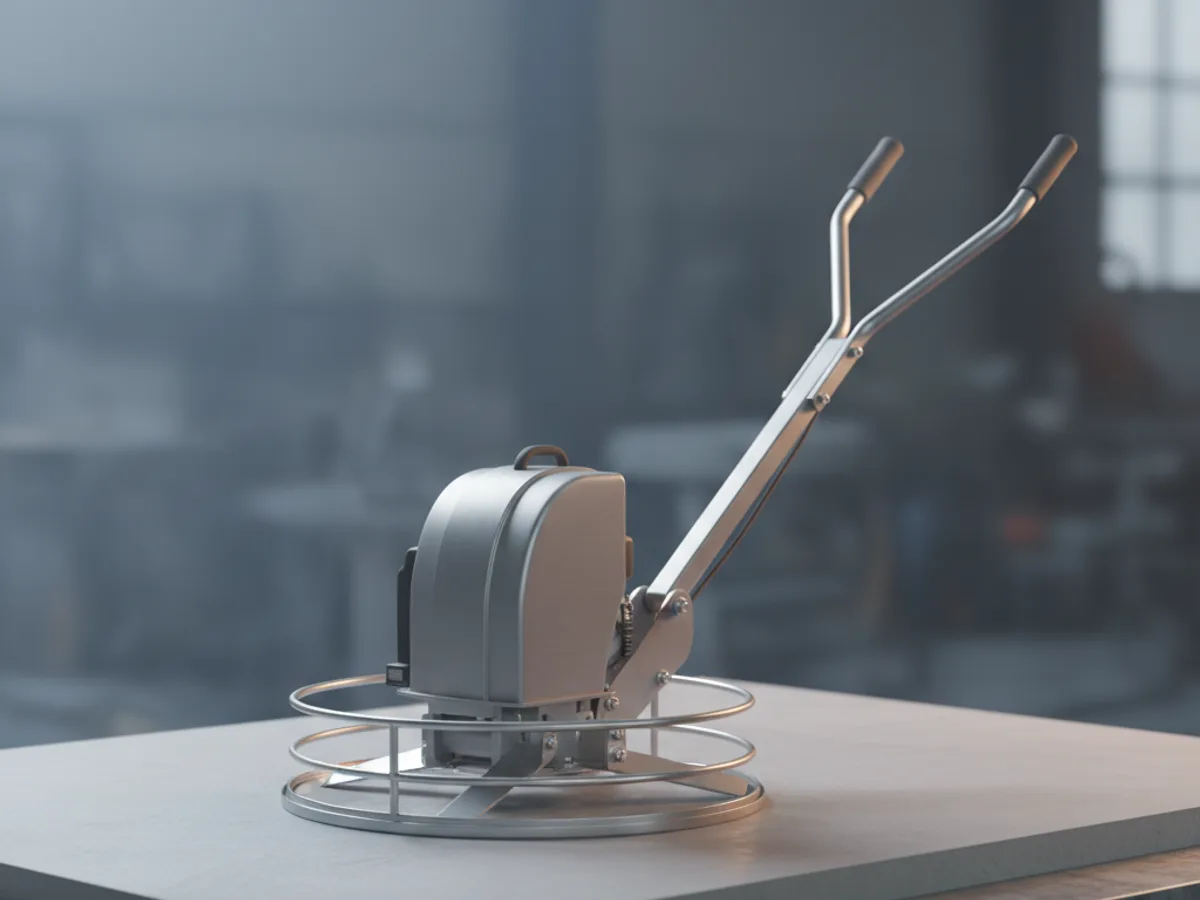
The float pan is a smooth disc bolted under the machine. It rides on the surface, flattens it, closes the texture and brings a little paste up, and because it spreads the load over a large area it can start earlier than blades can.
Finishing blades come afterwards. They are narrow, they concentrate the machine weight, and they are set at a pitch that starts flat and is progressively steepened over successive passes. Each pass tightens and polishes the surface further, and the slab has to stiffen between passes for the next one to achieve anything.
Trying to skip the pan and start on blades on a soft surface digs and gouges. Trying to burnish at a steep pitch too early does the same. The sequence exists because each step needs the surface a little harder than the last.
Walk behind and ride on
A walk behind machine has one rotor and is steered by tilting the handle, which uses the torque of the rotor to walk the machine sideways. It suits bays, smaller pours and the areas a large machine cannot enter, and it is tiring over a full day.
A ride on trowel carries two counter rotating rotors and covers ground several times faster. On a large pour that is not a comfort decision: the concrete sets on its own schedule, and if the machine cannot cover the area within the finishing window then part of the slab is finished late whatever anyone does.
Whichever machine, the operator control that matters is the deadman switch on the handle, which stops the rotor the moment it is released. A running trowel left to itself travels, and its blades are moving fast enough to do serious damage.
Edges, curing and what floating cannot fix
A power float cannot reach the last hundred millimetres against a wall, a column or a rebate, because the guard ring stops before the edge. That perimeter is finished by hand with a trowel and an edger, worked to match the machine finish, and it is the part that gives away a rushed job.
Curing after finishing matters as much as the finishing itself. Concrete gains strength by hydration, not by drying, so a slab that loses water quickly to sun or wind ends up weaker at the surface and crazes. Cover it, spray a curing compound, or keep it damp, and do it as soon as the surface will take it.
Finally, floating is a surface operation. It will not correct a slab that was placed to the wrong level, a mix that was too wet, or reinforcement in the wrong place. Those are decided before the machine comes off the van, and no amount of trowelling recovers them.