


Current rating is continuous, not peak
The figure on a bus bar, 250 A or 600 A, is what the bar can carry continuously without exceeding its temperature rise. It is not a fuse rating and it does not protect anything. Nothing about fitting a 600 A bar makes the circuit safer; it simply means the bar is not the limiting part.
Size it above the largest continuous load you expect rather than to the sum of every branch, because branches rarely all draw at once, but leave real headroom. A bar running near its rating in a hot engine bay or a sealed locker is hotter than the same bar on a bench, and the ratings assume reasonable ventilation.
The bar still needs overcurrent protection ahead of it. Fusing every branch but leaving the incoming feed unfused means a short at the bar itself has nothing to clear it, and at these currents that is a fire rather than a blown fuse. Fuse the feed close to the battery, then fuse each branch for its own cable.
| Stud | Typical use | Note |
|---|---|---|
| M6 or 1/4 inch | Accessory circuits, lighting, small loads | Lugs are easy to find, torque is low |
| M8 | General 12 V distribution, mid current | The common size on 250 to 400 A bars |
| M10 | Battery banks, inverters, winches | Used on 500 to 600 A bars |
A loose terminal is a heater
Every joint on a bus bar has a contact resistance, and power lost in that resistance rises with the square of the current. At a few amps a slightly loose nut is invisible. At two hundred, the same joint gets hot, the heat oxidises the contact faces, the oxidation raises the resistance further, and the joint runs away until something melts. Almost every burnt distribution block failed this way rather than from being undersized.
Tighten to the maker figure with a torque wrench rather than by feel. Overtightening is its own failure: it stretches the stud, deforms the lug and can crack the moulding, and a stud that has yielded will never hold torque again.
Re-check the joints after the first heat cycles and then periodically, particularly on anything that vibrates. Use one lug per stud where the design allows, stack larger lugs below smaller ones where it does not, and keep the mating faces clean and flat.
Why the cover is part of the product
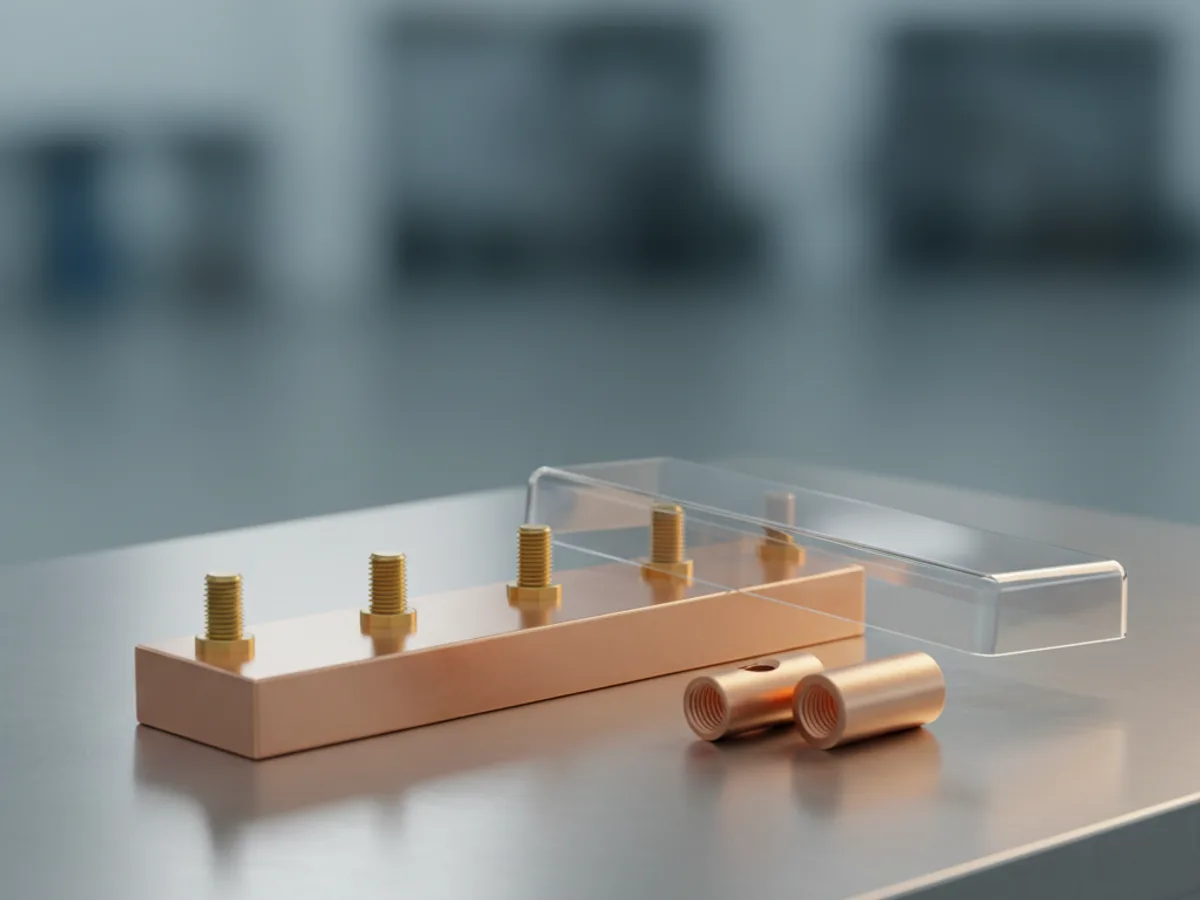
An exposed bus bar carrying a few hundred amps from a battery bank is an unfused short waiting for a dropped spanner. Battery chemistries in this class can deliver thousands of amps into a dead short, which vaporises the tool, sprays molten metal and can rupture the battery. The insulated cover is the difference between a dropped tool and an incident.
Fit the cover and keep it fitted. Where a bar is mounted in a locker or under a seat, that is exactly the place something will eventually be dropped or slide into it, and a bar that is easy to reach for maintenance is equally easy to reach with a bag of tools.
On boats and vehicles, mount the bar where it cannot collect water and where cables approach without strain. Marine grade bars use tinned copper for a reason: bare copper in a salt atmosphere grows a resistive oxide at exactly the joints where you cannot afford one.
Getting the cable onto the stud properly
The lug has to suit both the cable and the stud. A lug crimped on cable that is too small for it will pull out under vibration, and a lug hole larger than the stud lets the joint move and lose torque. Match the crimp to the conductor cross section and the barrel to the stud diameter.
Crimp with a proper hydraulic or ratchet tool rather than a hammer die or pliers. A cold crimp on heavy cable is a gas-tight joint when done correctly and a high resistance connection when it is not, and the difference is invisible from the outside. Heat shrink over the barrel keeps moisture out of the strand ends.
Give every cable a little slack and support it near the block. The stud is not a cable clamp, and a heavy cable hanging on its lug works the joint loose over months of vibration. Cable ties to a nearby anchor take that load off the terminal.