
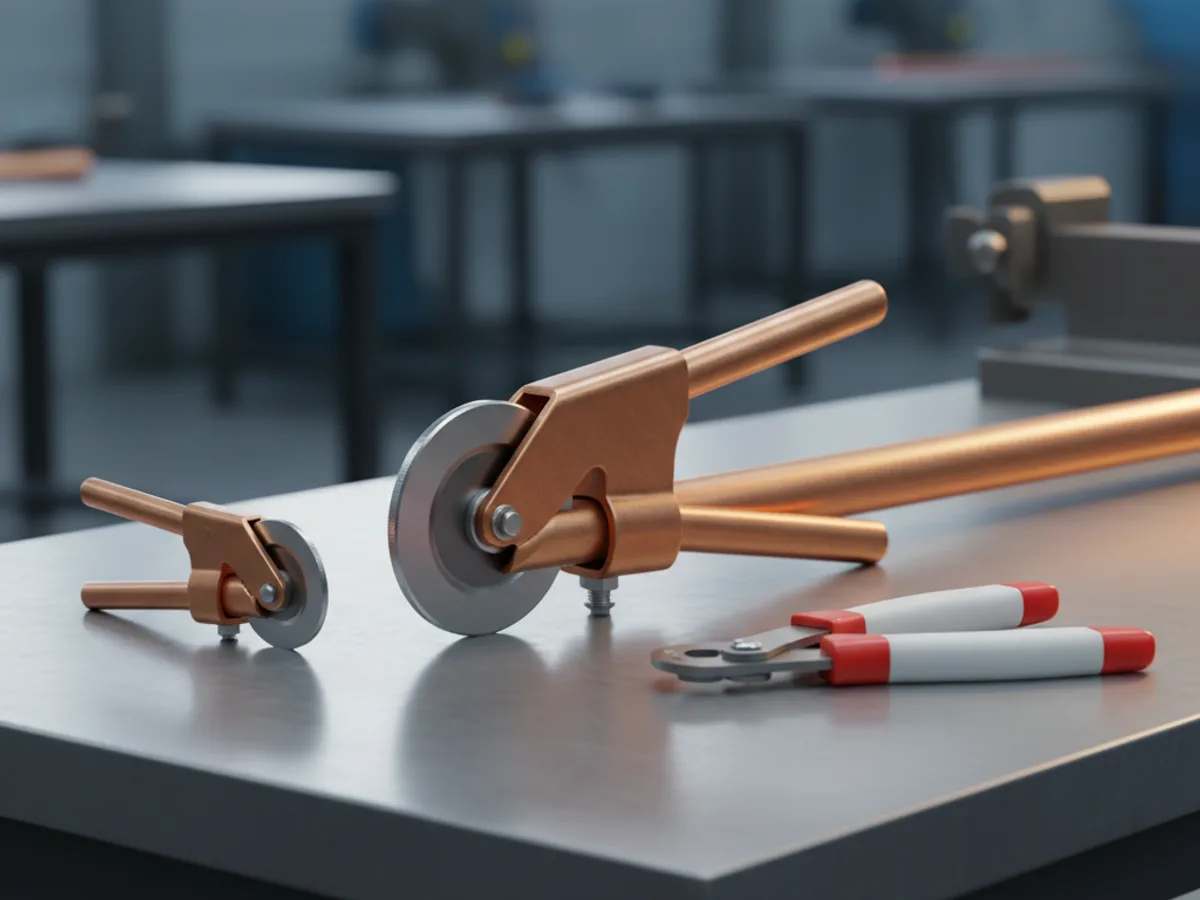


Little and often beats squeezing
The cutting wheel is thin and hard, and its job is to displace metal progressively rather than to slice through in one pass. Tighten the knob just enough to bite, rotate the cutter fully around the pipe, then tighten another quarter turn and go round again.
Over tightening does two things, both bad. It pinches the pipe out of round immediately behind the cut, so a compression olive or a solder fitting has an oval surface to seal against, and it forces a much larger burr inward. On thin walled copper you can feel the pipe give as it happens.
It also destroys wheels. A wheel driven too hard chips at its edge and then tears rather than cuts, which leaves a ragged end and a cutter that seems to have gone blunt overnight. Wheels are a consumable and cheap; replacing one is quicker than fighting a bad cut.
| Pipe | Cutter | Note |
|---|---|---|
| Copper tube | Wheel cutter | Standard wheel, light progressive pressure |
| Stainless tube | Wheel cutter with a stainless wheel | A copper wheel dulls almost immediately |
| Plastic pipe and PEX | Scissor or ratchet cutter | A blunt blade crushes rather than cuts |
| Tight spaces | Mini or auto cutter | Works with little clearance around the pipe |
Deburring is not optional
Every wheel cut rolls a burr inward at the bore. Left in place it restricts flow, and in a system with any velocity it creates turbulence right at that point, which is where erosion corrosion begins in copper. On a long run of small bore pipe, a dozen unremoved burrs add up to a measurable loss.
It also spoils joints. A burr holds a compression olive off its seat and stops a push fit collet gripping evenly, and the leak that follows is blamed on the fitting rather than the cut.
Most cutters carry a folding reamer for exactly this, and it takes seconds. Ream the inside, take the outside edge back lightly so the pipe enters the fitting cleanly, and wipe the swarf out rather than letting it travel into the system.
Plastic pipe wants a different tool
A wheel cutter on plastic pipe tends to plough rather than cut, leaving a raised ridge and an end that is not square. Plastic and multilayer pipe are cut with a scissor or ratchet action instead, where a single sharp blade passes straight through in one movement.
Blade sharpness is the whole story with these. A sharp blade leaves a clean square face; a dull one squashes the pipe oval as it forces its way through, and a push fit joint made on an oval end is a leak waiting for a pressure test. Blades are replaceable and should be replaced rather than persevered with.
Cut square and cut once. Sawing back and forth with a ratchet cutter leaves a stepped face, and pipe that has been squeezed out of round needs the deformed section cutting off rather than pushing into a fitting and hoping.
Working in tight spaces
The limitation of a standard cutter is swing: it needs room to rotate all the way around the pipe. Behind a cistern, under a floor or against a wall there frequently is not that much room.
Mini cutters shrink the body so the swing circle is much smaller, and automatic or self feeding cutters take it further, ratcheting round the pipe while tightening themselves so nothing has to be turned by hand at all. On a copper pipe tight against a joist they are the difference between a clean cut and a hacksaw.
Where even that will not fit, an internal tube cutter works from inside the pipe, which is how a pipe flush to a wall gets cut back. It is a specialist tool and worth knowing exists before cutting a hole in plaster to make room for a standard one.