
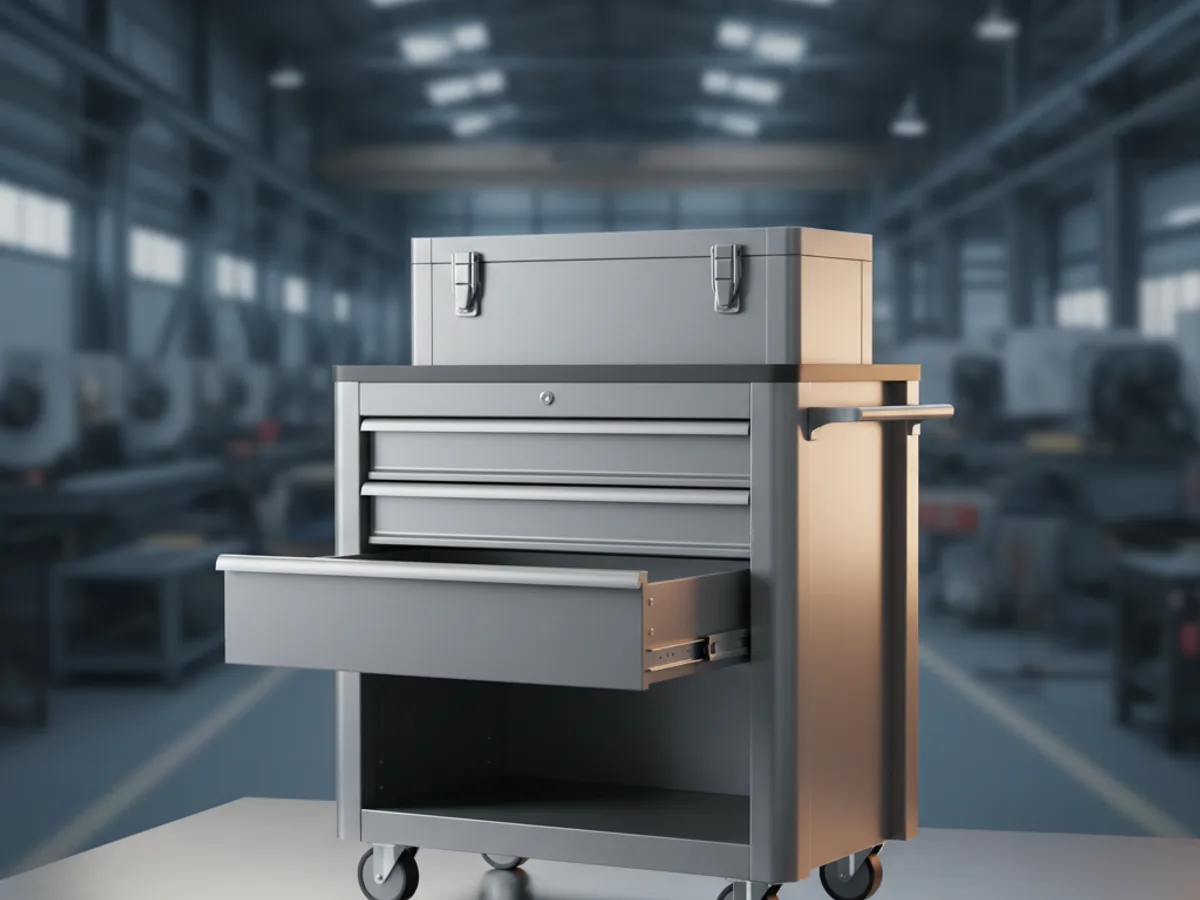


Chest, intermediate and roller cabinet
The traditional arrangement is a roller cabinet on castors at the bottom, an optional intermediate chest, and a top box with a lifting lid. Each part is sold separately and they stack, which is how a set grows with the work rather than being bought in one go.
The roller cabinet does the heavy carrying. It holds the mass, it takes the castors, and its worktop becomes the surface everything else sits on, so it is worth putting most of the budget there. A weak bottom cabinet under a good top box is a bad stack.
A top box with a lifting lid gives a deep tray for the awkward items that fit no drawer. It also has to be opened by moving everything off the lid, which is why many people end up preferring an all drawer arrangement once the stack is in daily use.
| Specification | Why it matters | Good sign |
|---|---|---|
| Per drawer load rating | Whether drawers work when full | Stated per drawer, not just total |
| Slide type | How drawers run under load | Ball bearing, full extension |
| Anti-tilt mechanism | Stops the cabinet tipping | Only one drawer opens at a time |
| Castor size and type | What it rolls over | Larger wheels, two braked swivels |
Drawer slides are the whole quality question
Cheap cabinets use friction slides, where the drawer runs on folded steel. Empty they feel acceptable. Loaded with sockets and spanners they stiffen, then bind, then stick at an angle, and the drawer that will not open is the drawer with the tool you need.
Ball bearing slides carry the load on rolling elements and stay smooth when full. Full extension slides bring the whole drawer clear of the cabinet, so the tools at the back are reachable rather than being fished out by feel. Both together are the practical difference between a cabinet you like and one you tolerate.
Test this rather than reading it. Pull a drawer out fully, press down on the front corner, and see whether it drops, twists or grinds. That five second check separates cabinets more reliably than any specification on the box.
Tipping, loading order and castors
A tall cabinet with the heavy drawers at the top and several drawers open at once will go over, and it goes over onto whoever opened it. Load heavy items in the bottom drawers, which lowers the centre of gravity and is also easier on the back.
An anti-tilt mechanism only allows one drawer to open at a time, which removes the failure mode entirely. On a cabinet that will be loaded properly it feels like an irritation; on a busy cabinet in a workshop it is the feature that prevents an accident.
Castors decide where the cabinet can go. Small hard wheels stop dead at a cable ramp, a door threshold or a chip of swarf, and larger wheels roll over them. Two fixed and two braked swivel castors is the usual arrangement, and the brakes are worth using whenever the cabinet is being worked out of on a floor with any slope.
Foam inserts, security and what steel gauge means
Shadow foam inserts cut to the shape of each tool turn a drawer into a visual check. At the end of a job an empty recess says immediately which tool is still in the vehicle or the machine, which is why aviation and rail workshops use them and why they are worth the effort anywhere a lost tool causes real trouble.
Steel thickness is quoted as a gauge, where a smaller number is thicker steel. It shows up in how much the worktop deflects when something heavy lands on it and how well the drawer fronts resist being dented. Thicker steel is heavier, which is fine on a cabinet that mostly stays put.
Be realistic about locking. A central locking bar keeps drawers shut in transit and keeps casual hands out, and no tool cabinet is a security container. Anything genuinely valuable belongs somewhere else, and insurers generally take the same view.