
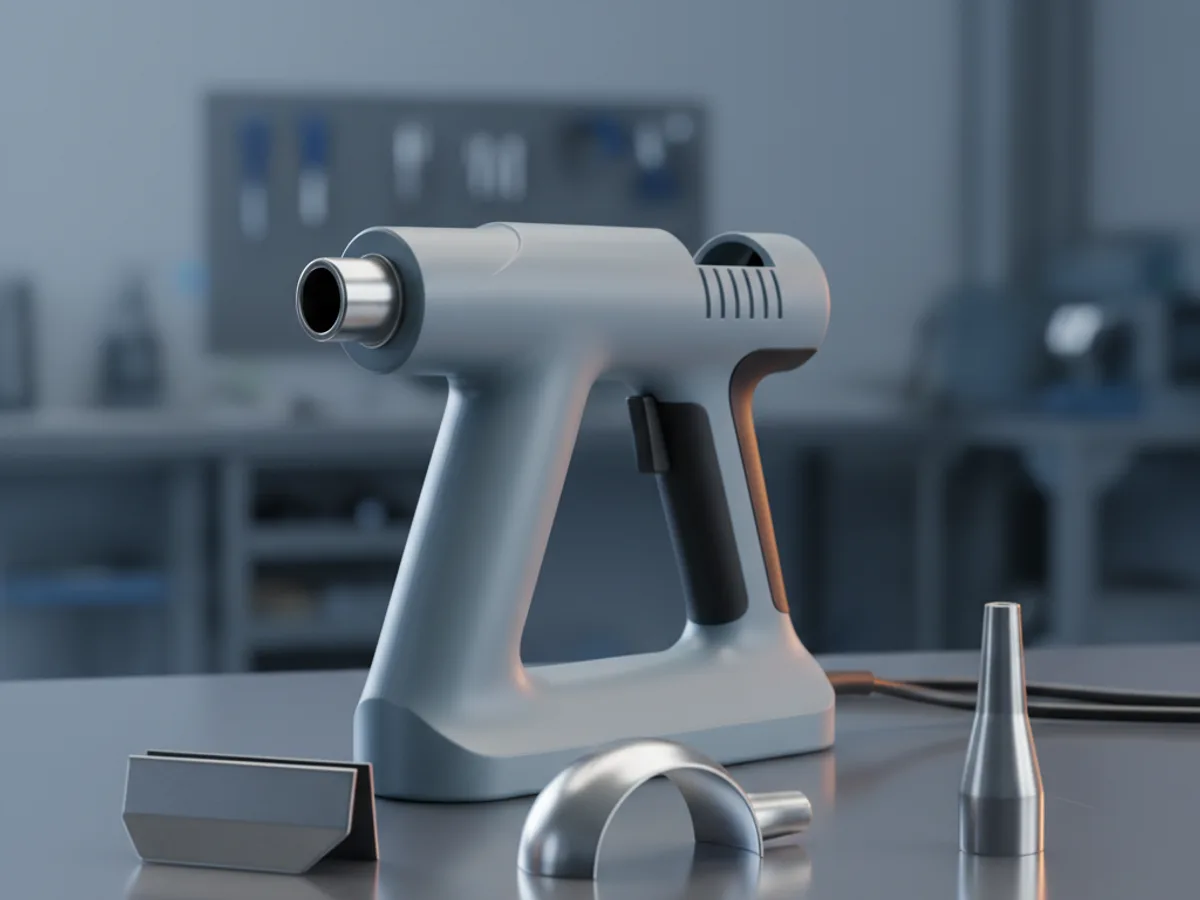


Temperature and airflow are different controls
Cheap guns often have two settings, meaning low and high on both heat and fan together. That is enough for paint stripping and too crude for anything delicate, because the only way to reduce the heat is to reduce the air with it.
Guns with separate control let you run a lot of air at a modest temperature, which is what you want over a large area such as shrink film, or a little air at high temperature for a concentrated spot. Variable temperature in reasonable steps, with airflow adjustable separately, is the specification that makes a gun genuinely versatile.
Ranges are broad. Shrink tubing recovers well below the top of any gun range, plastic welding sits in the middle, and paint softening is near the top. Being able to set and repeat a temperature matters more than the maximum figure on the box.
| Job | Heat needed | Note |
|---|---|---|
| Shrink tubing and film | Low to moderate | Keep moving, moderate air over a wide area |
| Softening adhesive and stickers | Low to moderate | Heat the adhesive, not the substrate |
| Thawing and drying | Low | Never on plastic pipe at high heat |
| Plastic welding | Middle of the range | Needs a matched welding nozzle |
| Paint softening | High | Read the old paint warning first |
Nozzles do most of the work
A bare gun blows a wide cone of hot air, which is fine for large areas and wasteful and imprecise for anything else. Nozzles shape that stream, and having the right one usually matters more than the gun.
A reflector nozzle wraps the air around a pipe, which is how you shrink tubing evenly rather than scorching one side. A glass protector deflector directs heat away from a pane while you work on a frame. A reducer concentrates the stream on a small area, and a fishtail spreads it into a wide flat band for stripping.
Fit nozzles cold and remove them cold. They reach the same temperature as the air and stay hot long after the gun is switched off, and picking one off a bench is a burn people only make once.
The old paint warning
Heat is a common way to soften paint for scraping, and on modern paint it is straightforward. On older buildings it is not, because paint applied decades ago may contain lead, and heating lead paint produces fumes and fine dust that are genuinely hazardous, particularly to children and to anyone pregnant.
Before stripping paint in an older property, establish what the paint is. Test kits exist, and where lead is present or suspected the safe methods are chemical stripping or wet abrasion by a competent person rather than heat.
Even on modern paint, work with ventilation and eye protection, and never assume a painted surface has nothing behind it. Heat carried through a gap ignites dust and old timber in cavities, and a fire started behind a skirting board or under a windowsill can smoulder unseen for hours before it shows.
Setting it down, cooling down and cordless
A heat gun does not glow, so nothing about it looks dangerous once it is switched off, and the nozzle stays hot enough to ignite paper or scorch a bench for several minutes. Use the stand or the flat rear of the body it was designed to rest on, and give it somewhere non combustible to sit.
Many guns have a cool down mode that runs the fan without the element. Using it is worth the extra thirty seconds, because it takes the heat out of the element and the nozzle rather than leaving it to soak into the housing.
Cordless guns have become genuinely useful for short jobs: shrink tubing on a loom, freeing a fixing, softening a seal. They will not sustain paint stripping across a room on a battery, and that is the honest division. For a workshop that already runs a battery platform, one is a convenient addition rather than a replacement for a mains gun.