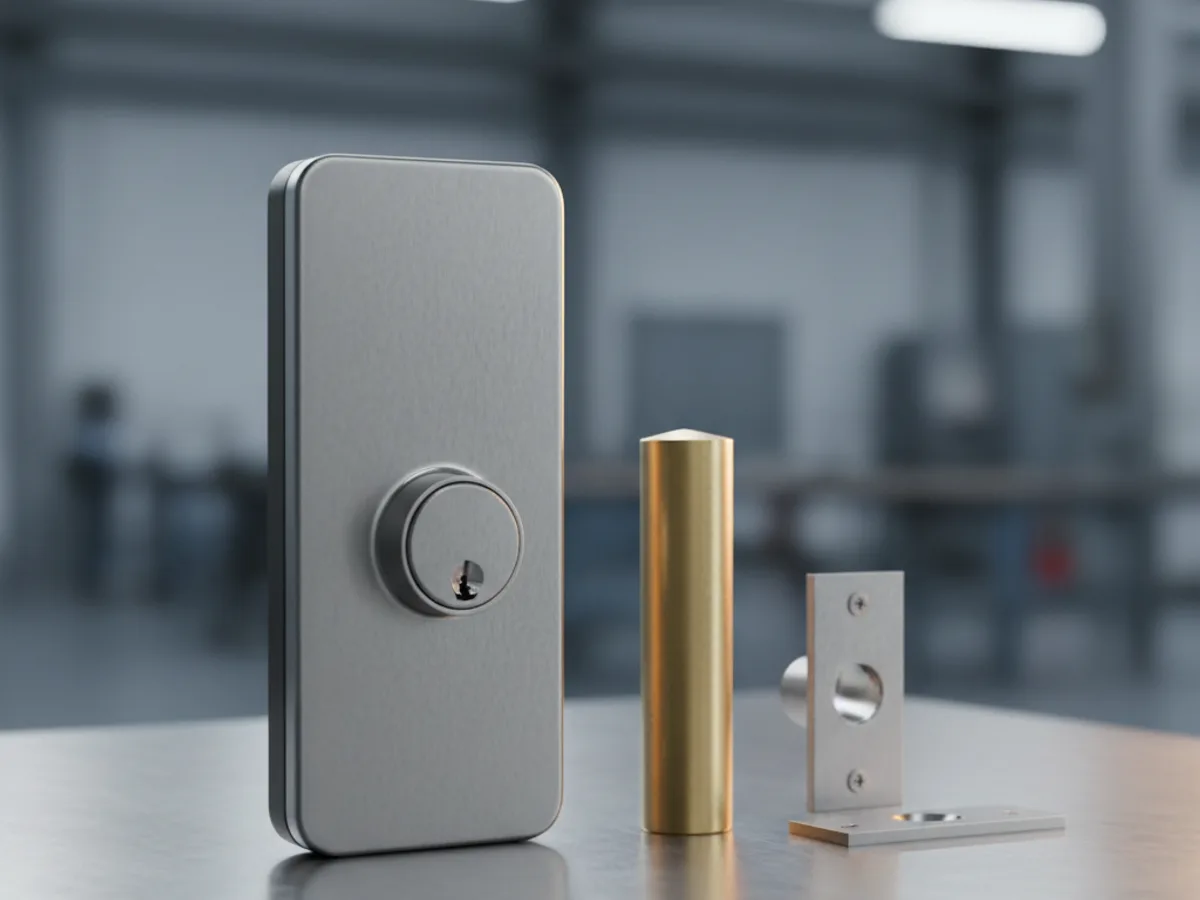


Backset, thickness and what is already bored
Backset is the distance from the edge of the door to the centre of the large hole. Two figures dominate, and a lock made for one will leave the handle either uncomfortably close to the edge or fouling the frame if forced into the other. Measure it before ordering rather than after.
Door thickness sets the length of the spindle and the fixing screws. Most locks state a range, commonly something like 35 to 60 millimetres, and a door outside that range needs a different lock or an extension kit rather than optimism.
On a door that is already bored, the existing hole pattern is the real constraint. A replacement that uses the same standard pattern goes straight on; one that does not means filling and reboring, which on a veneered or glazed door is a bigger job than the lock cost.
| Measurement | Why it matters |
|---|---|
| Backset | Sets handle position; wrong one fouls the frame |
| Door thickness | Sets spindle and screw length |
| Existing hole pattern | Decides whether it is a swap or a rebore |
| Handing and opening direction | Some locks are handed and some are reversible |
Latch, deadbolt and what each secures
A latch holds a door closed and is retracted by the handle. It resists the wind, not a person. A deadbolt is thrown deliberately and does not retract under pressure on the door, which is what actually resists forcing.
Bolt throw, meaning how far the bolt projects, is the specification that matters on a deadbolt, together with what it engages. A long bolt into a shallow plastic keep achieves very little, so the strike plate and its fixings into the frame timber are as important as the lock body.
On an external door the sensible arrangement is both: a latch for everyday use and a deadbolt for security. Where one lock does both, check the deadbolt is a proper bolt rather than a latch with a lock button, since those are not the same thing.
Keyless entry, and how it fails
Keypad, fingerprint, card and app locks all remove the key from everyday use, and the practical question is what happens when the electronics do not cooperate. Batteries go flat, usually at the least convenient moment, so a mechanical override key and a way to hear or see a low battery warning are the features that matter.
Some locks add an external contact for a power bank to supply enough energy to open the door if the batteries die completely. Where the lock is on a building people rely on getting into, that is a better answer than a key hidden nearby.
App and network features are worth being clear eyed about. A lock that depends on a cloud service to open is a lock that depends on somebody else remaining in business and online. Local control that works without the internet, with the app as a convenience, is the more robust arrangement.
Commercial doors, electric release and fire doors
On access controlled doors the language changes. Fail safe means the door unlocks when power is removed; fail secure means it stays locked. Which one is correct is a life safety decision, not a preference: an escape route generally has to release on loss of power, while a secure store generally must not.
That decision belongs with the building fire strategy rather than with whoever fits the lock. Getting it backwards is the kind of error that is invisible until the day it matters.
Fire doors are stricter again. A fire door is a tested assembly, and its hardware is part of what was tested, so hinges, closers and locks must all be certified for it. Fitting an uncertified lock, or boring a fire door for one, voids the rating of the whole door regardless of how well the work is done.