


Airflow or static pressure, and why they trade off
Airflow, quoted in cubic feet per minute or cubic metres per hour, is how much air a fan moves into open space. Static pressure, quoted in millimetres of water, is how hard it can push against something that resists. The two are ends of the same curve: a fan optimised for one gives up the other.
That matters because most cooling problems are actually restriction problems. Behind a dust filter, through a dense heatsink or a radiator, or into a sealed cabinet with a small vent, a high airflow fan stalls and delivers far less than its rating suggests. A pressure optimised fan, usually with more blades and a smaller gap to the frame, keeps moving air against that resistance.
So match the fan to what is in front of it. Open case intake or a simple exhaust hole is an airflow job. Filter, fin stack, or a restricted duct is a static pressure job, and using the wrong one is the most common reason a fan swap makes no measurable difference.
| Situation | Optimise for | Why |
|---|---|---|
| Open case intake or exhaust | Airflow | Little to push against, volume is what counts |
| Behind a dust filter | Static pressure | The filter resists, an airflow fan stalls on it |
| Through a heatsink or radiator | Static pressure | Dense fins are a large restriction |
| Sealed cabinet with a small vent | Static pressure | The vent, not the fan, sets the limit |
Bigger is quieter for the same air
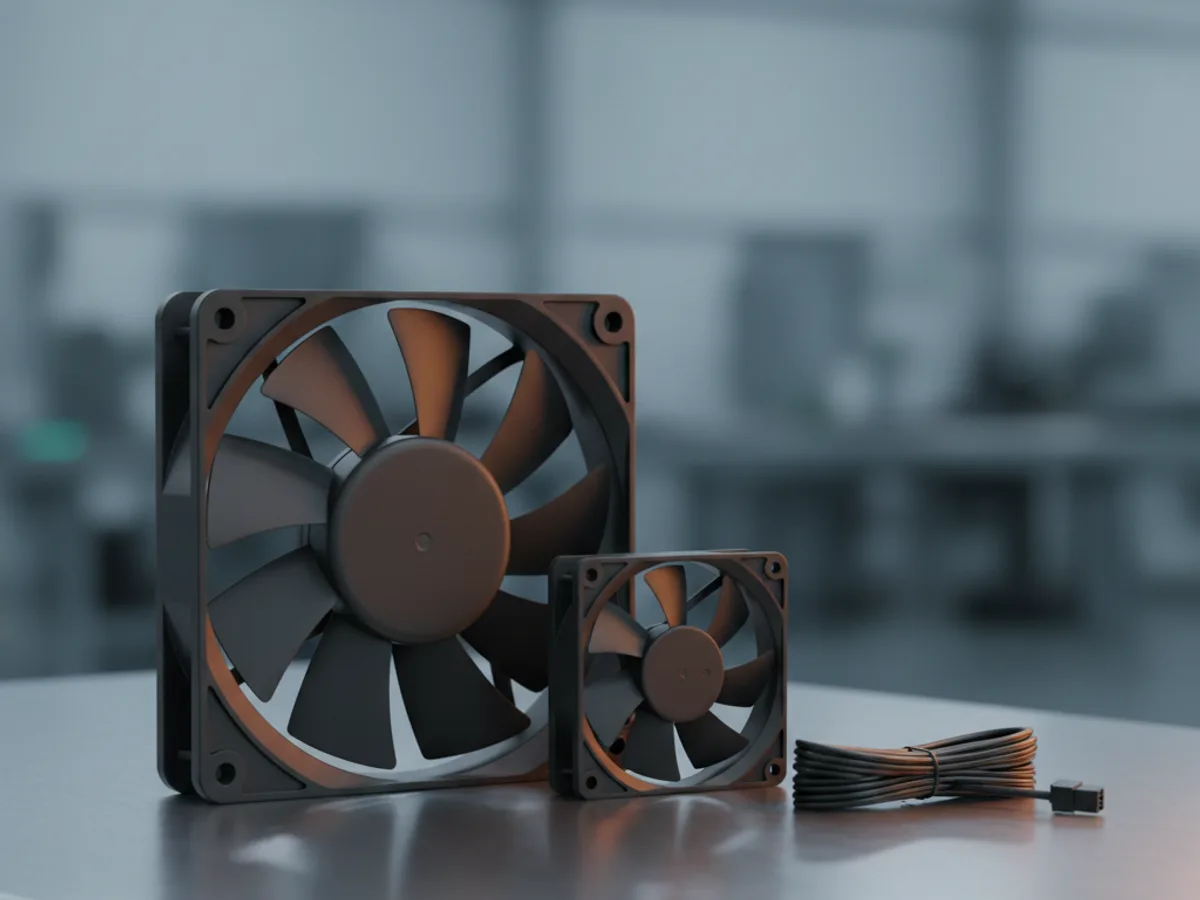
Fans come in a standard ladder of sizes, commonly 40, 60, 80, 92, 120 and 140 millimetres, and the mounting holes go with the size. A larger fan moves a given volume of air at a lower speed than a small one, and noise rises very steeply with speed, so the bigger fan doing the same work is markedly quieter.
The practical rule is to fit the largest fan the opening takes rather than the fastest fan that fits. Where an enclosure is being built or modified, cutting for a 120 mm fan instead of an 80 mm one is usually the single biggest improvement available to both noise and cooling.
Thickness varies too, most commonly 25 mm but with slim 15 mm versions for tight spaces. A slim fan gives up both airflow and pressure for the same diameter and speed, so use one only where the depth genuinely will not take a standard fan.
Bearings decide life and mounting orientation
Sleeve bearings are the cheapest and the shortest lived, and they have an orientation preference: they last considerably longer with the shaft vertical than horizontal, because the lubricant stays where it is needed. In a horizontally mounted fan running continuously, a sleeve bearing is the part that fails.
Ball bearings last far longer, tolerate any orientation and higher temperatures, and are usually a little noisier with a characteristic higher pitched note. They are the sensible choice for equipment that runs continuously in any position.
Fluid dynamic or hydraulic bearings sit between the two, aiming for the quietness of a sleeve with much of the life of a ball. Where a datasheet quotes a rated life in hours, read it alongside the temperature it is quoted at, because bearing life falls sharply as temperature rises.
Three wires or four, and which way the air goes
A two wire fan runs at one speed. A three wire fan adds a tachometer output so the controller can read its speed, and it is throttled by varying the supply voltage, which works until the voltage drops too low for the fan to start reliably. A four wire fan takes a PWM control signal on the fourth wire while the supply stays at full voltage, which lets it run much slower without stalling and lets it restart from stopped.
For anything where quiet running at low load matters, four wire PWM is worth having. For a simple always-on cooling job, a two or three wire fan on a fixed supply is simpler and cheaper.
Airflow direction is marked on the frame, usually as an arrow on the side alongside a second arrow for blade rotation. Fitting one backwards is easy and undoes the whole airflow plan. Decide the plan first: more intake than exhaust gives positive pressure, which pushes air out through every unfiltered gap and keeps dust out, while more exhaust gives negative pressure and pulls dust in through every gap you did not think about.