
What the category number buys you
Cat5e handles gigabit comfortably over a full run and is still fine for most desk connections. Cat6 tightens the specification and supports 10 gigabit, but only over a shortened distance, commonly quoted at around 55 metres and less in a crowded bundle. Cat6a is built for 10 gigabit across the full 100 metre channel, which is why it is the sensible choice for permanent structured cabling being installed now.
Above that, Cat7 and Cat8 exist and are specified to higher frequencies, with Cat8 aimed at very short data centre links between switches and servers rather than at general building cabling. For a normal installation they add cost and stiffness without adding anything the equipment can use.
The category is a property of the whole channel, not just the cable. A Cat6a run terminated in Cat5e modules or joined with a Cat5e patch lead performs as the weakest part, so buying good cable and cheap connectors gets you the cheap connector.
| Category | Practical capability | Sensible use |
|---|---|---|
| Cat5e | Gigabit over a full run | Existing installs, desk patching |
| Cat6 | 10G over shortened distance | Short runs where 10G is wanted |
| Cat6a | 10G over a full 100 m channel | New permanent cabling |
| Cat8 | Very high frequency, very short links | Data centre switch to server only |
Solid core or stranded, and the CCA warning
Solid core cable has one conductor per wire. It performs slightly better over distance and it is what punch-down modules and keystone jacks are designed to bite into, so it is the right choice for a permanent run inside a wall or a trunk. It does not like being flexed repeatedly and will eventually fracture if used as a patch lead.
Stranded cable has many fine strands per conductor, which makes it flexible and tolerant of being moved, coiled and trodden on. That is what a patch lead should be, and stranded cable does not terminate reliably in punch-down hardware, so the two are not substitutes.
The thing to avoid entirely is copper clad aluminium. It is aluminium wire with a thin copper skin, sold cheaply and often described only as CCA in the small print. It has higher resistance than copper, it does not meet the standards it claims, and it is brittle at the terminations. On Power over Ethernet the higher resistance turns into heat in the bundle and voltage lost along the run, which is why it fails exactly where it matters. Look for pure copper.
Shielding only works when it is earthed
Unshielded cable relies on the twist in each pair to reject interference, and in an ordinary office or home that is enough. Shielded cable adds a foil around each pair, a braid around the whole bundle, or both, and it is worth having where cable runs alongside mains, near large motors or drives, or through an industrial environment.
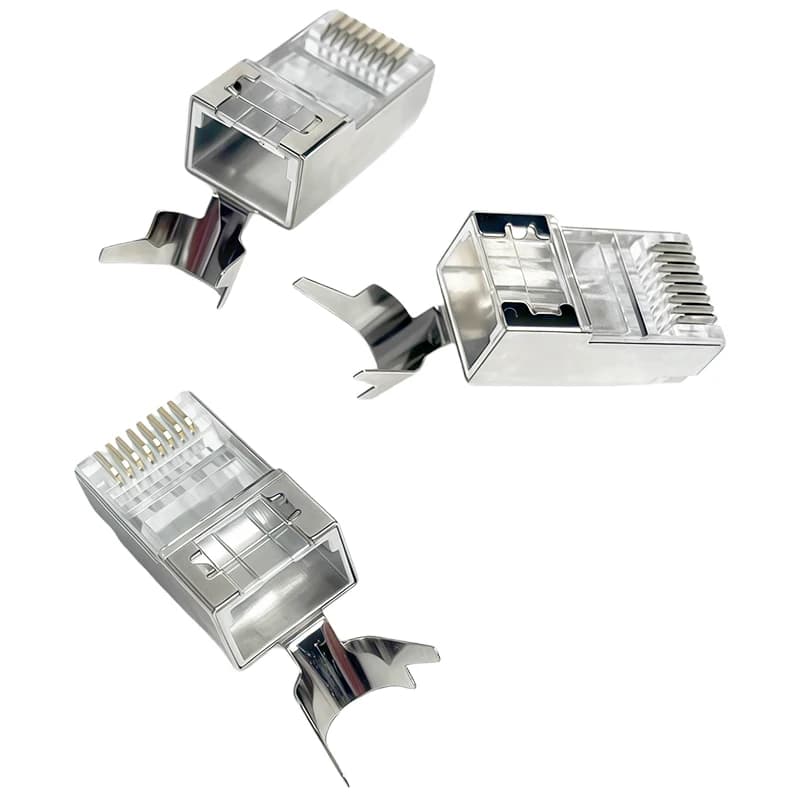
The shield has to be connected to earth to do anything. That means shielded connectors, shielded patch panels and modules, and a deliberate earth at one end of the run. A shielded cable terminated in unshielded connectors is an unshielded cable that costs more and is harder to pull.
Earth it at one end only. Earthing both ends of a long run can create a path for current to flow through the shield between two points at slightly different potentials, and that induces exactly the noise the shield was fitted to prevent.
Bend radius, pulling tension and PoE heat
Twisted pair is a precision product and treating it roughly changes its electrical behaviour. Kinking a cable, pulling it hard round a corner or cable tying it tight all deform the pair geometry, and the result is a run that tests marginal or intermittent for reasons that are invisible afterwards.
Keep the bend radius generous, pull gently and by hand where possible, and use hook and loop straps rather than tight cable ties on bundles. Where a cable has to turn a corner in a trunk, a sweeping bend costs nothing and preserves the performance you paid for.
Power over Ethernet adds heat. Current flowing in the conductors warms them, and a large tight bundle in a warm ceiling void holds that heat in, which raises resistance and further reduces the power reaching the far end. Bundle loosely, avoid packing PoE runs together in one dense group, and keep the total run length within the standard rather than at its limit.