
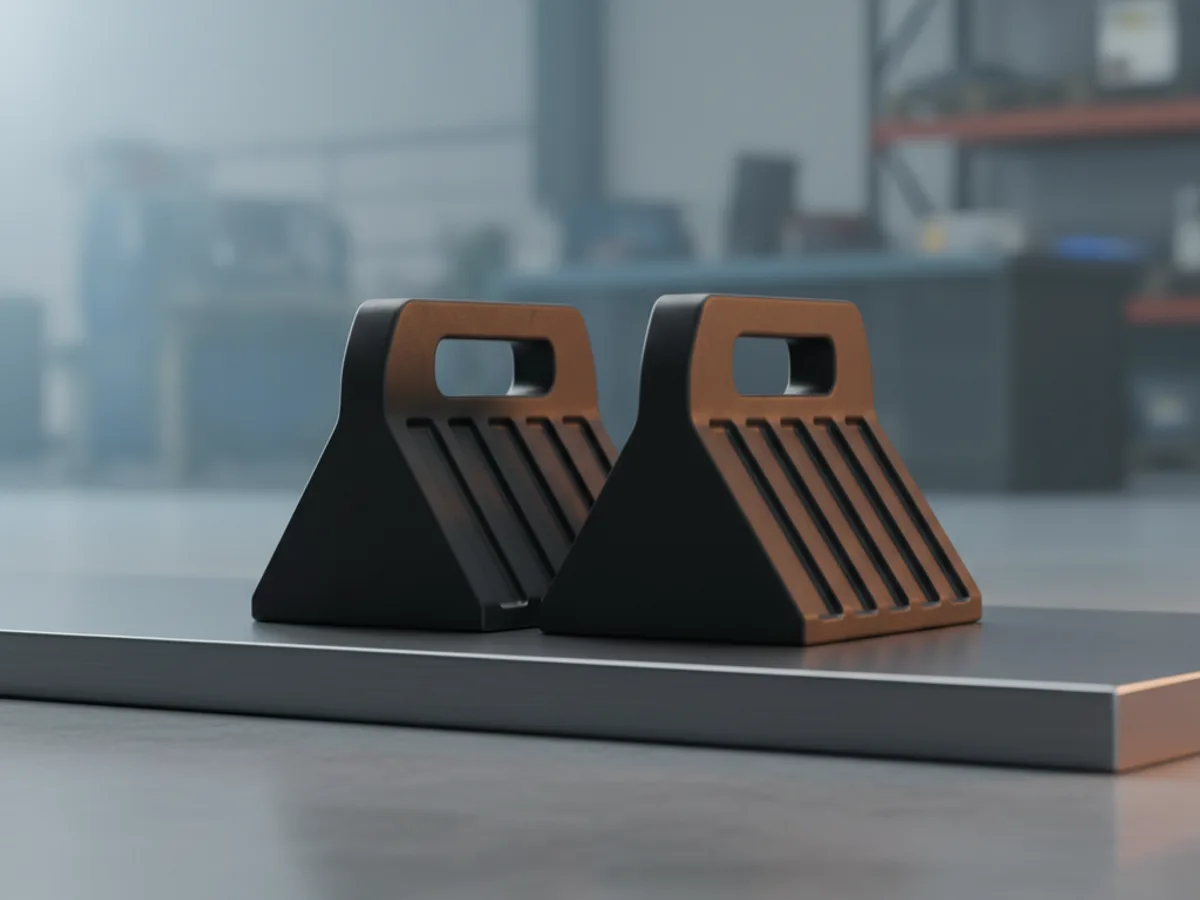


Sizing a chock to the tyre
The physics is simple: a wheel rolls over a chock when the contact point is low enough that the tyre can climb it. The taller the tyre, the taller the chock has to be, which is why chocks are sold in ranges rather than as one size.
A common guide is that the chock should reach roughly a quarter of the tyre height, and heavier vehicles need more than lighter ones because there is more force pushing the wheel forward. A caravan or a trailer on a slope generates a great deal more than people expect.
Contact area matters as well as height. A chock with a curved face that matches the tyre profile spreads the load, and a flat faced chock touches the tyre on a line. Both work; the curved one works with less tendency to be pushed out.
| Factor | Effect | Rule of thumb |
|---|---|---|
| Chock height | Whether the tyre climbs it | Around a quarter of tyre height |
| Face shape | How load spreads on the tyre | Curved holds better than flat |
| Base grip | Whether the chock slides | Rubber on concrete, teeth on soft ground |
| Material | Weight, life and cold behaviour | Rubber for grip, plastic for weight |
Which side to chock, and how many
On a slope the load wants to move downhill, so the chock goes on the downhill side of the wheel, hard against the tyre. Placed on the uphill side it does nothing until the vehicle has already rolled the length of the gap.
On the flat, or where the direction of any movement is uncertain, chock both sides of the wheel. That is standard practice for a trailer or caravan that has been uncoupled, because the tow vehicle is no longer holding it and a handbrake is a mechanism that can be knocked off or can fail.
Two chocks on one axle, one each side of the vehicle, is the sensible minimum for anything uncoupled. Push them firmly into contact rather than resting them near the tyre, because a chock with a gap in front of it lets the load build up speed before it arrives.
Rubber, plastic and steel
Solid rubber is the workhorse. It grips concrete and tarmac well, it takes ultraviolet and temperature without becoming brittle, and it is heavy, which is both the reason it stays put and the reason it is unpleasant to carry a pair around.
Moulded plastic chocks are far lighter and are what most caravanners actually carry. Good ones are ribbed for stiffness and have a toothed base for soft ground. The weakness is cold: some plastics become brittle in a hard frost, and a cracked chock found on a winter morning is a chock that was fine in October.
Steel and aluminium chocks handle the heaviest vehicles and can slide on smooth concrete unless they have a rubber pad or teeth. For yard and loading bay use they are usually chained to the building, both so they are present when needed and so they are not carried off.
Levelling ramps are not chocks
A levelling ramp is a wedge the wheel is driven up to bring a caravan or motorhome level on uneven ground. It is doing a completely different job from a chock, and being on one does not stop the van rolling back down it.
So a ramp always needs a chock behind the wheel that is standing on it. That is the step most often missed, and it is the one that matters, because a van on a ramp is on a slope by definition.
Chocks also have nothing to do with supporting a lifted vehicle. They stop it rolling, which is a precondition for jacking safely, and the weight is taken by axle stands. A chock under a raised wheel is doing nothing at all.