



Voltage must match, current only has to be enough
Voltage is what the adapter pushes and the equipment has no say in it. Too high and you are over-volting the device, which is how things get destroyed; too low and it either will not run or misbehaves in ways that look like a fault elsewhere. Match it exactly to what is printed on the equipment.
Current works the other way round. The rating is the most the adapter can supply, and the device draws what it needs. A 12 V 5 A adapter running a 12 V 2 A device supplies 2 A and runs cool, which is why fitting a higher current adapter is safe and often sensible.
That leaves the trap of undersizing. An adapter run at or above its rating gets hot, its output sags under load, and cheap ones fail short of their printed figure. Sizing for headroom, something like half again the device draw, is the habit that avoids a supply that works on the bench and drops out under real load.
| Specification | Rule |
|---|---|
| Output voltage | Exact match, no tolerance to play with |
| Polarity | Must match the symbol on the equipment |
| Barrel size | Must match, and similar sizes are not interchangeable |
| Output current | Equal or higher than the device draw, headroom is good |
Polarity and barrel size, the two silent mismatches
Every device carries a small symbol showing which conductor of the barrel is positive: a circle with a dot at the centre, a line, and plus and minus signs. Centre positive is the common convention and it is not universal, and equipment that meets the wrong polarity may be destroyed instantly or may simply sit dead. Check the symbol on both adapter and device rather than assuming.
Barrel sizes are the other quiet failure. The two common ones, 5.5 by 2.1 mm and 5.5 by 2.5 mm, share an outer diameter and differ only inside. A 2.1 mm plug pushes into a 2.5 mm socket and makes an intermittent contact that works when you set it down and cuts out when the cable moves, which presents as a fault in the equipment.
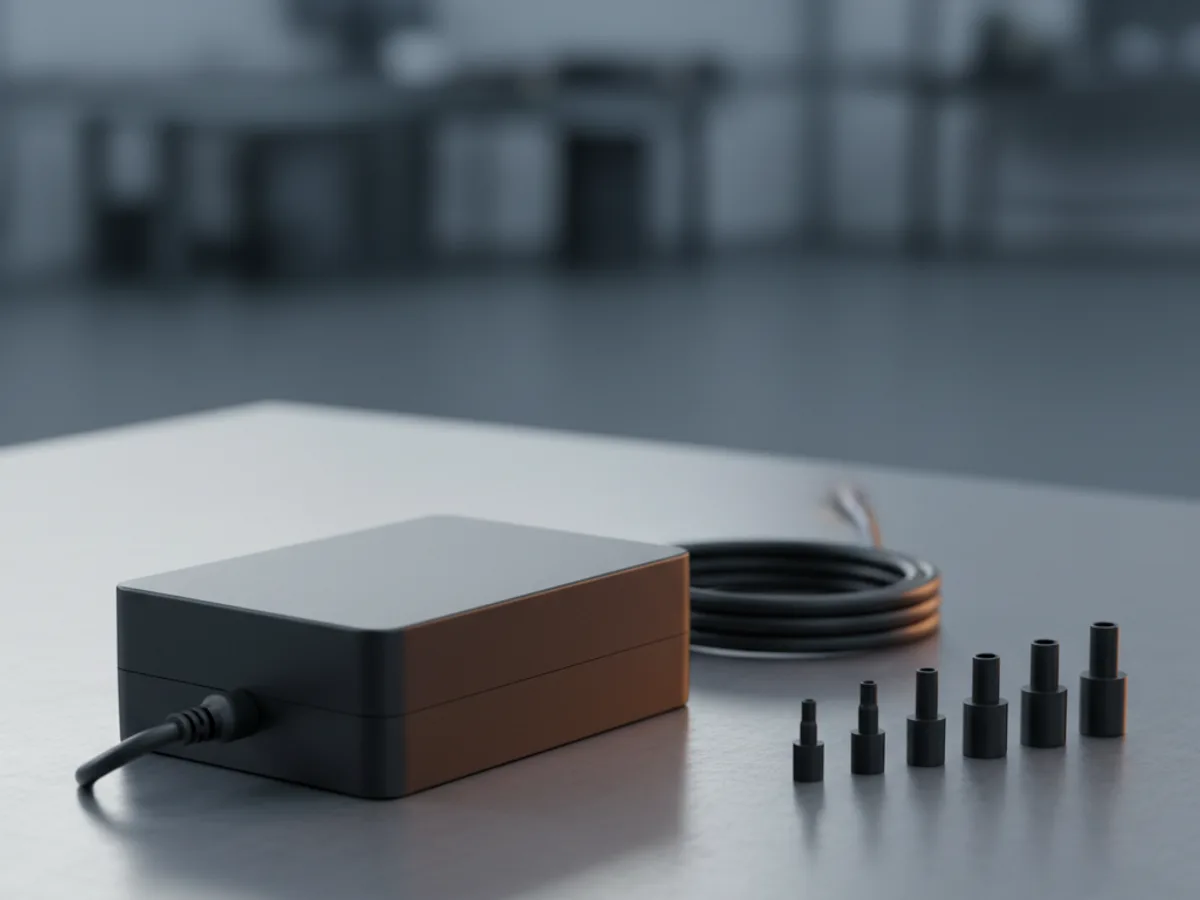
Where a supply comes with a set of interchangeable tips, that is genuinely useful and it puts the polarity question back on you, since some tip sets are reversible. Fit the tip, then check the output with a meter before plugging anything expensive into it.
Regulated, unregulated and what the efficiency mark means
A regulated supply holds its output voltage across its load range. An unregulated one, essentially a transformer and rectifier, sits well above its nominal voltage at light load and sags towards it as the load rises. Feeding modern electronics from an unregulated supply nominally at the right voltage can therefore put far more than that across it at idle.
Almost everything sold now is a regulated switching supply, and that is what you want, but it is worth checking on very cheap or very old stock. The clue is size and weight: a heavy adapter for its rating is likely a linear transformer type.
Efficiency marks describe how much power is wasted as heat and, importantly, how much the adapter draws doing nothing. Something left plugged in permanently, which is most of them, is worth choosing on no-load draw as well as on its rating.
LED drivers are not interchangeable with adapters
Many supplies in this category are sold for LED work, and there are two different kinds. A constant voltage driver holds a fixed voltage, typically 12 or 24 V, and is what LED strip needs, because the strip has its own current limiting resistors built in.
A constant current driver holds a fixed current and lets its voltage float to whatever the load needs. That is what bare LED arrays and many fittings require, because without series resistors the current has to be controlled by the supply.
Swapping them destroys things. Constant voltage into an array with no current limiting runs away and kills the LEDs; constant current into a strip either fails to light it properly or drives it wrongly. The listing states which it is, and matching that to the load is the whole decision.