
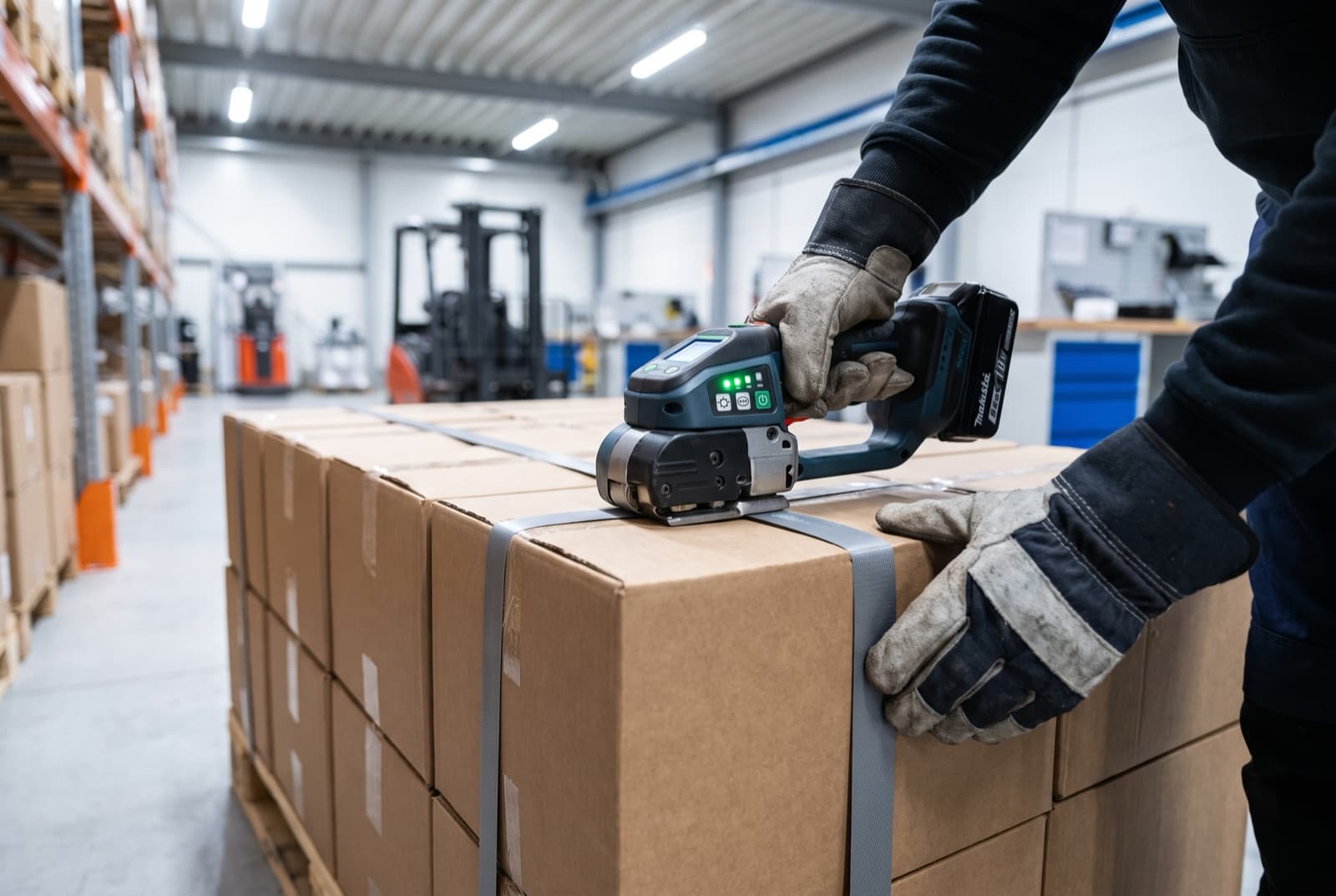
To use a banding machine, pass the strap around the load and feed the loose end back into the slot: the machine tensions the loop, welds the overlap and cuts the tail in about a second. By hand it is the same three actions done separately, with a tensioner and either a crimped seal or a weld.
Quick answer
- Thread the band, tension it, then join the overlap and cut the tail.
- Plastic strap is friction welded. Steel strap needs a metal seal or a notched sealless joint.
- Use edge protectors on cardboard corners or the tension disappears into the box.
- Polypropylene relaxes within hours. Use polyester on anything that has to travel or wait.
How to use a banding machine
A semi-automatic table machine keeps the strap coil underneath and presents the end through a slot in the table. Put the load on the table, pass the strap around it by hand, and push the loose end back into the slot. The machine grips it, pulls the loop to the tension set on the dial, friction welds the overlap and cuts the strap in about a second.
Set the tension before the first load rather than adjusting it mid-run, and set the weld time to the strap you are actually running. A weld that is too short peels apart under load; one that is too long thins the strap at the joint and it snaps there. If joints are failing, look at the weld setting before you blame the strap.
How to use a hand banding tool
With a separate tensioner and sealer, wrap the strap around the load and overlap the two ends by a hand span. Fit the tensioner over both layers, then crank or lever until the band is tight enough that it does not lift off the load when you pull it. Slide a seal over the overlap, crimp it with the sealer, and cut the tail off close.
A battery combination tool collapses that into one operation. Lay the overlapped ends into the jaws, hold the trigger, and it tensions to the preset figure, friction welds the joint and cuts the tail. It is the usual answer for pallets that are already built and standing on the floor, because it works one-handed at ground level.
Bands over the top of the load and down the sides hold the load to the pallet. Bands round the middle only hold the load to itself. If the pallet and the goods have to arrive together, at least one strap has to go over the top.
Which strap to run
Polypropylene is the cheap one and it stretches a long way without recovering, so a PP band tensioned this morning is looser this afternoon. That is fine on a carton going out today and wrong on a pallet standing in a yard for a fortnight. Polyester holds its tension and takes up the slack as the load settles, which is why it has replaced steel on a lot of palletised freight.
Steel is still the answer for rigid, heavy or sharp-edged loads, because nothing matches its break strength and it barely stretches. The catch is that it gives nothing back: if the load settles even slightly, the band goes slack and stays slack. Steel also cannot be friction welded, so it needs a crimped seal or a sealless notch joint.
| Strap | Holds tension | Joint | Use it for |
|---|---|---|---|
| Polypropylene | Poor, relaxes in hours | Friction weld or seal | Cartons, light bundling |
| Polyester | Good, recovers as the load settles | Friction weld or seal | Pallets, timber, most freight |
| Steel | No stretch, but no recovery | Metal seal or sealless notch | Steel stock, castings, sharp loads |