316 and 304 stainless steel properties
The mechanical figures are close enough that you would not choose between them on strength. The difference is chemistry, and specifically the molybdenum in 316 that resists pitting in chloride environments.
The L grades, 304L and 316L, carry lower carbon so they can be welded without carbide precipitation at the weld. If the part is welded and will see corrosive service, specify the L grade.
| Property | 304 | 316 |
|---|---|---|
| Chromium | 18 to 20 | 16 to 18 |
| Nickel | 8 to 10.5 | 10 to 14 |
| Molybdenum | None | 2 to 3 |
| Carbon max | 0.08 (0.03 for 304L) | 0.08 (0.03 for 316L) |
| Yield strength, min | 205 MPa (30 ksi) | 205 MPa (30 ksi) |
| Tensile strength, min | 515 MPa (75 ksi) | 515 MPa (75 ksi) |
| Elongation, min | 40% | 40% |
| Hardness, max | 201 HB | 217 HB |
| Magnetic | No when annealed | No when annealed |
| Density | 8.0 g/cm³ | 8.0 g/cm³ |
When 316 is worth the premium
316 costs 20 to 40 percent more than 304 depending on the market. It earns that in three places: anywhere near the sea or on a road that gets salted, anywhere chlorine or chlorides are present including swimming pools and food processing, and in chemical or pharmaceutical service.
304 is the right choice for kitchen equipment, indoor architecture, fresh water and general fabrication. Specifying 316 there is money spent on corrosion resistance the part will never need.
The tell-tale failure of 304 in the wrong place is tea staining, the brown surface spotting on stainless near the coast. It is cosmetic at first and becomes pitting if left. 316 in the same spot stays clean far longer.
Reading stainless steel markings
Fasteners are marked with the steel group and property class. A2 is the 304 family and A4 is the 316 family. The number after the dash is the property class: A2-70 is 304-type stainless with a minimum tensile strength of 700 MPa, A4-80 is 316-type at 800 MPa.
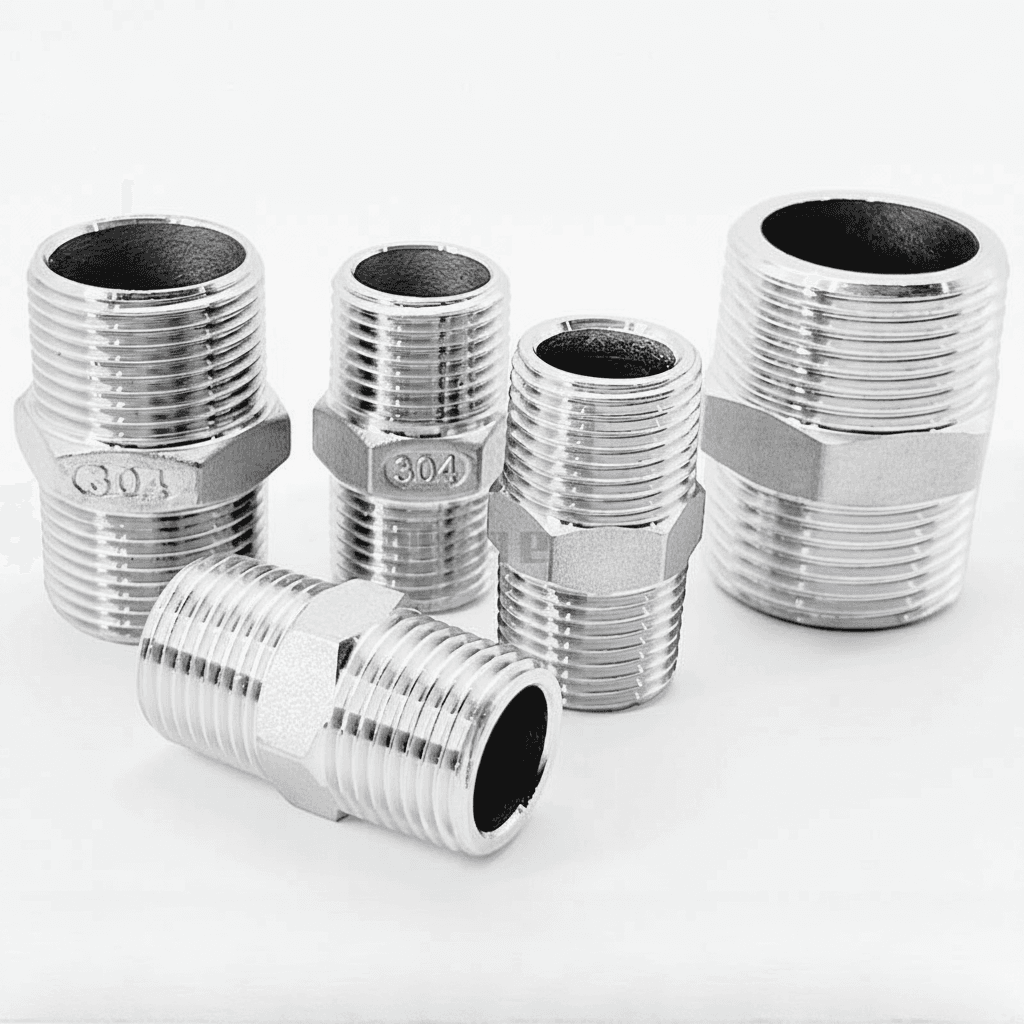
Sheet and bar carry the grade number, often with the standard: 304, 316, 316L, or the European 1.4301 for 304 and 1.4401 for 316. If a part carries no marking, a magnet is a rough guide since both grades are non-magnetic when annealed, but it will not tell 304 from 316. A molybdenum spot test kit will.
| Grade | UNS | EN number | Fastener mark |
|---|---|---|---|
| 304 | S30400 | 1.4301 | A2 |
| 304L | S30403 | 1.4307 | A2 |
| 316 | S31600 | 1.4401 | A4 |
| 316L | S31603 | 1.4404 | A4 |