
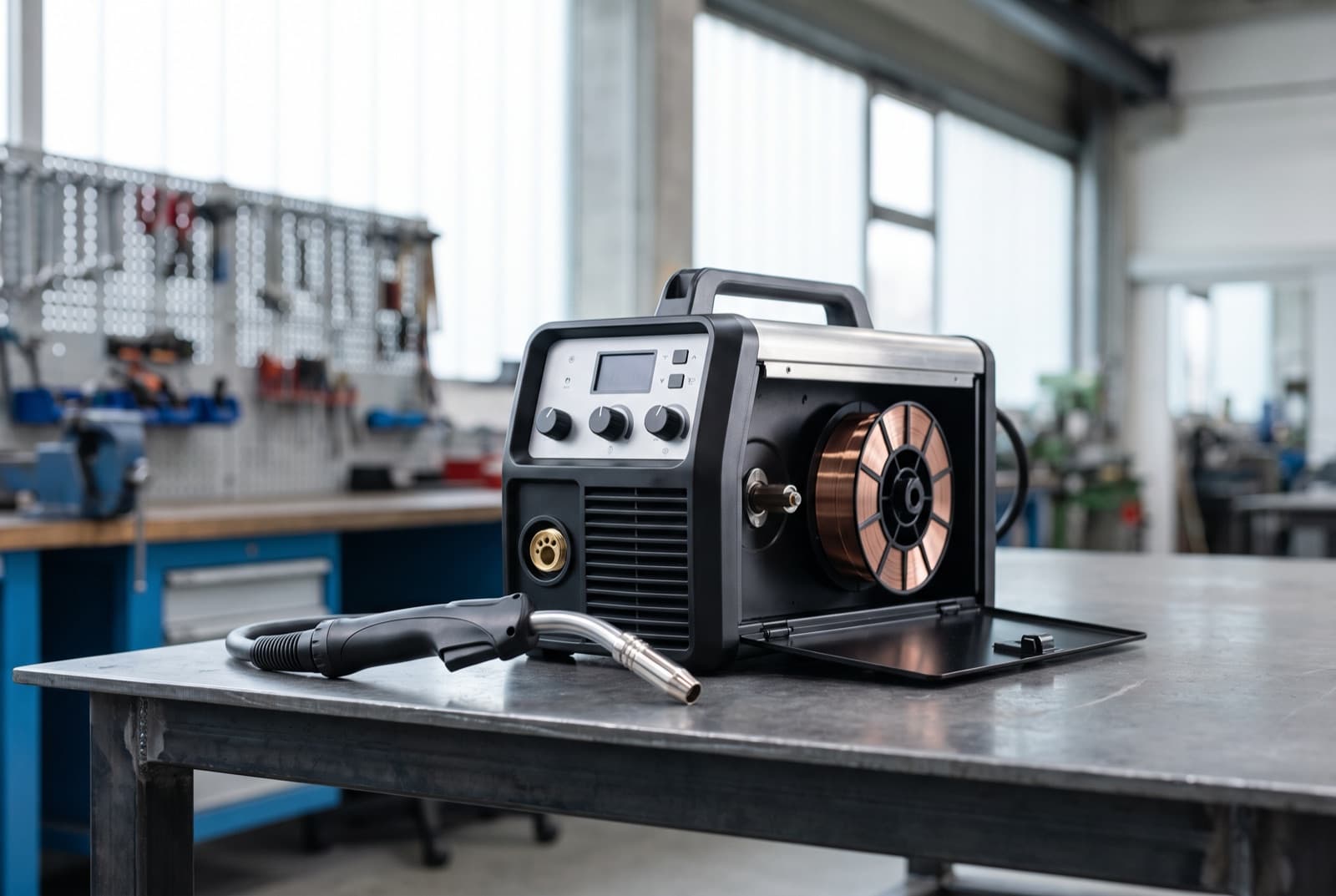
The best MIG welder for you is the one whose amp range covers the metal you weld, whose duty cycle survives the length of your runs, and whose wire feed is smooth and consistent. Brand matters far less than those three things. Everything else on the spec sheet is secondary.
Quick answer
- Match the amp range to your metal thickness: roughly 30 amps per millimetre of steel.
- Duty cycle tells you how long you can weld before the machine must rest.
- Gas MIG gives cleaner welds indoors; gasless flux-cored wire wins outdoors.
- Synergic control sets voltage and wire speed for you, which shortens the learning curve.
Amps, duty cycle and metal thickness
Amps decide how thick a section you can weld. As a rough rule, steel needs about 30 amps per millimetre of thickness, so 3 mm plate wants roughly 90 to 120 amps. Duty cycle is the other half of the answer: a machine rated 150 amps at 30 percent can weld for three minutes out of every ten at that setting before it needs to cool. Light repair work rarely troubles a duty cycle, but fabrication runs do.
| Steel thickness | Typical amps | Common use |
|---|---|---|
| 0.8 mm to 1.5 mm | 40 to 70 A | Car body panels, thin sheet |
| 2 mm to 3 mm | 70 to 120 A | Brackets, general repair |
| 4 mm to 6 mm | 120 to 180 A | Trailers, gates, frames |
| 8 mm and up | 180 A and up | Structural and heavy fabrication |
A MIG welder for beginners
If you are buying a first machine, favour a smooth wire feed and simple controls over a big headline amp figure. A wobbly feed roller causes more bad welds than low power ever will. Look for a machine that runs 0.6 mm and 0.8 mm wire, has a decent earth clamp, and gives you enough range to practise on 2 mm to 3 mm steel. That covers most learning and most home jobs.
Gas or gasless MIG welder
Gas MIG feeds solid wire and shields the weld with argon or an argon mix. It runs cleaner, spatters less and looks neater, which suits indoor bench work. A gasless MIG welder runs flux-cored wire that makes its own shielding gas as it burns, so it needs no bottle and holds up in wind. The trade is more spatter and slag to clean off. Many machines do both, which is the sensible default if you work indoors and out.
Is a synergic MIG welder worth it
On a synergic MIG welder you dial in the wire diameter and material, then set one knob, and the machine picks matching voltage and wire speed. It gets a beginner to a decent bead much faster and saves setup time on a busy shop floor. Experienced welders often still trim the settings by hand, so treat synergic as a convenience worth paying a little for, not a requirement.
Check the duty cycle at the amps you will really use, not the maximum. A 200 amp machine at 20 percent duty cycle spends four minutes in ten cooling down, which stalls a long fabrication run.