
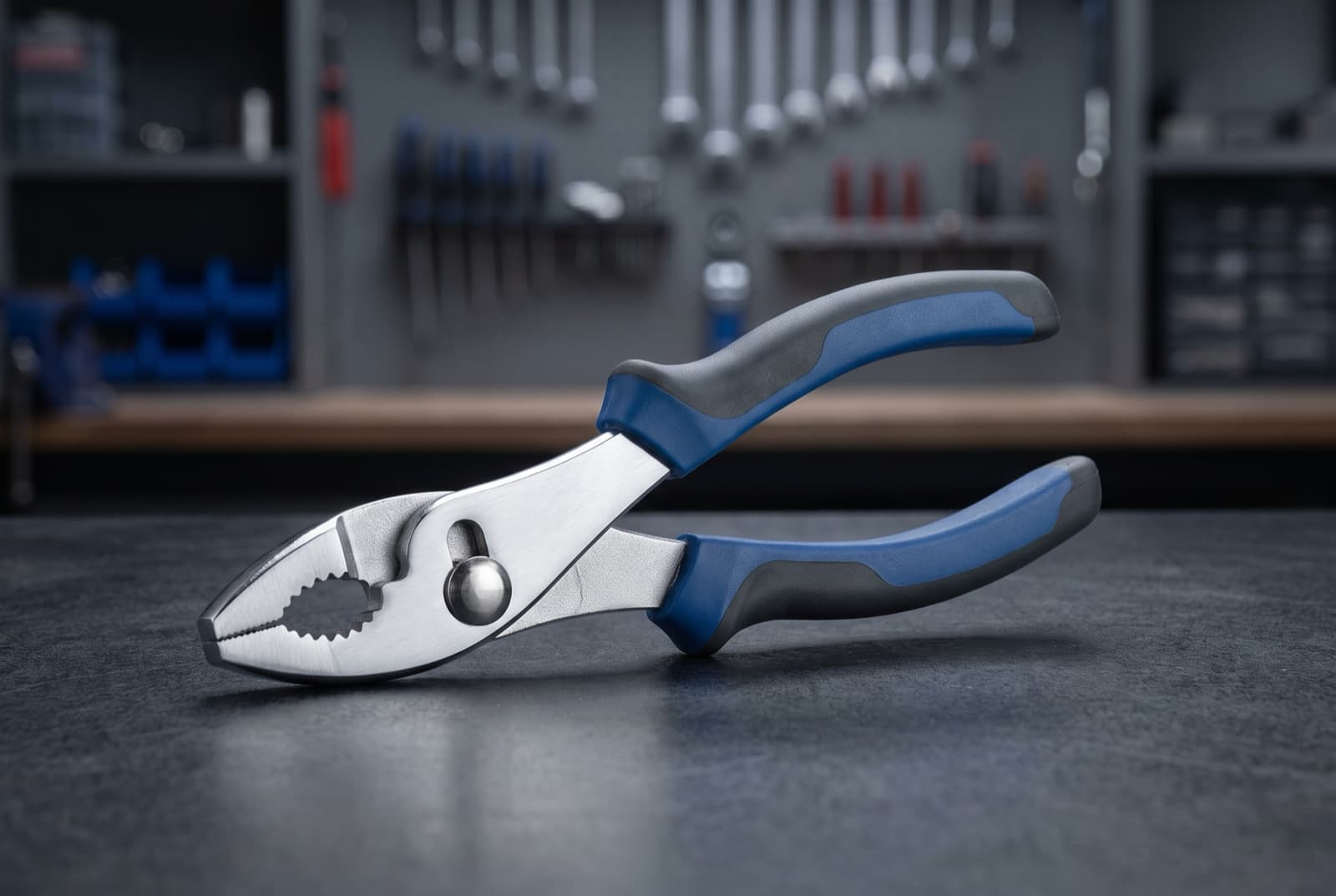
Slip joint pliers are general-purpose pliers with a pivot that slides between two positions, so the jaws can open wide or narrow to grip different sizes. The jaws have flat serrations near the tip for small flat objects and a curved, toothed section behind them for round stock like pipe and bolts. They are the do-everything pliers most people reach for first.
Quick answer
- The sliding pivot gives two jaw widths from one tool.
- Flat serrations grip small flat parts; the curved section grips round stock.
- They handle light gripping, bending and pulling, not heavy pipe work.
- For big adjustable range, water pump pliers are the bigger cousin.
What slip joint pliers are for
Slip joint pliers cover the everyday gripping jobs: holding a nut while you turn a screw, pulling a nail, bending light wire, or gripping a fitting that is slightly too big for the close jaw position. Slide the pivot to the wide setting and the same tool grips a larger nut or pipe. Many also have a wire cutter behind the pivot. They are a general tool, not a specialist one, which is exactly why they earn a place in every kit.
Slip joint vs water pump pliers
They look related and get confused, but they are different tools. Slip joint pliers have two positions and are sized for general light work. Water pump pliers, also called groove joint or tongue-and-groove pliers, have many more positions along a longer slot and much longer handles, so they open far wider and grip large pipe and fittings with real force. Reach for slip joint pliers for everyday jobs and water pump pliers for plumbing and big fasteners.
| Type | Adjustable | Best at |
|---|---|---|
| Slip joint pliers | Two positions | General light gripping, bending, pulling |
| Water pump pliers | Many positions | Large pipe and fittings, plumbing |
| Combination (lineman) pliers | Fixed | Gripping and cutting wire |
| Needle nose pliers | Fixed | Fine work in tight spaces |
| Locking pliers | Screw adjust | Clamping and holding hands-free |
How to use them safely
Set the pivot to the position that lets the jaws sit square on the work, not gaping open. Grip with the toothed section that matches the shape, flat serrations for flat parts, the curved jaw for round stock. Do not use pliers to turn a nut you can reach with a spanner, since the teeth round off the corners. And never extend the handles with a pipe for more leverage; that bends the tool and slips.
If the jaws keep slipping off a stubborn round part, you have probably reached the limit of slip joint pliers. Switch to water pump pliers or locking pliers, which bite harder and hold without constant hand pressure.