
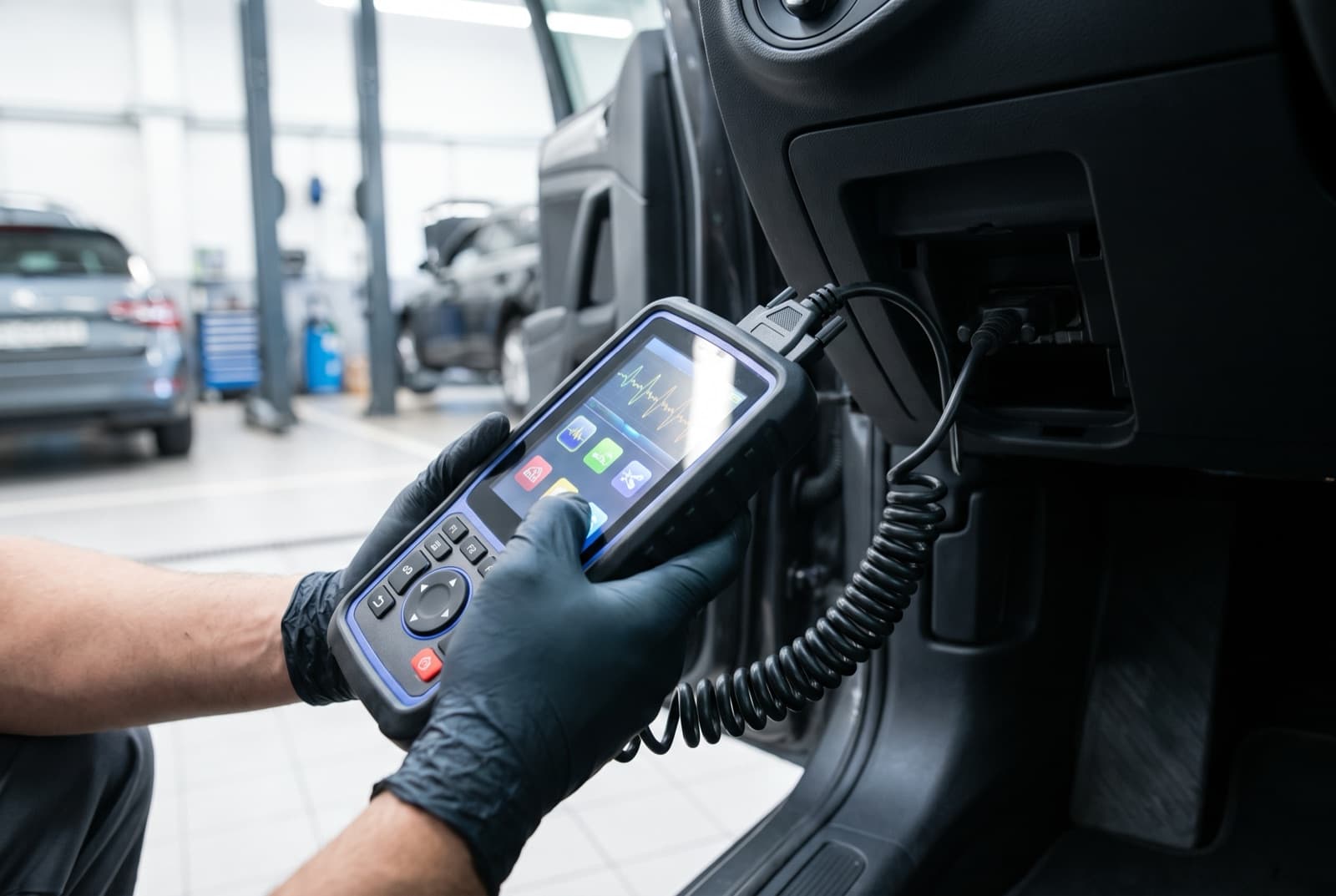
A car diagnostic scanner is a handheld or tablet tool that plugs into a vehicle’s OBD2 port and reads fault codes, live sensor data and system status from the car’s computers. A basic code reader shows and clears the codes behind a warning light. A professional diagnostic scanner goes further and talks to the ABS, airbag, transmission and other modules.
Quick answer
- Every car built since the mid-2000s has an OBD2 port a scanner plugs into.
- A code reader shows and clears engine fault codes only.
- An OBD2 scanner adds live data and more detail.
- A bidirectional scan tool can command parts to move, so you can test them.
What a diagnostic scanner does
When a warning light comes on, the car has stored a trouble code. A diagnostic scanner plugs into the OBD2 socket, usually under the dashboard, and reads that code so you know where to start. Better scanners also stream live data such as engine temperature, fuel trim and sensor voltages, which is how you tell a failing part from a healthy one before you spend money on it.
OBD2 scanner vs code reader
The two names get mixed up, but they are not the same tool. A code reader is the cheapest option and does one job: read and clear engine codes. An OBD2 scanner reads the same codes but adds live data, freeze-frame snapshots and often more systems than the engine alone. If you only want to know why the check-engine light is on, a reader is fine. If you want to diagnose the fault, you want a scanner.
| Tool | Reads codes | Live data | Other modules | Commands parts |
|---|---|---|---|---|
| Code reader | Yes | Basic or none | Engine only | No |
| OBD2 scanner | Yes | Yes | Some (ABS, airbag) | No |
| Bidirectional scan tool | Yes | Yes | All major modules | Yes |
Professional and bidirectional scan tools
A professional diagnostic scanner reads every major module, not just the engine, so it catches ABS, airbag and transmission faults a basic reader never sees. A bidirectional scan tool goes one step further: it can command a component to act, such as cycling an ABS pump or firing an injector, so you can prove whether the part works. For a working garage that active testing is what turns guesswork into a confirmed fix.
Check coverage before you buy. A scanner that supports your common makes and gets regular software updates is worth far more than one with a longer feature list on paper but no updates.